Showing posts with label Zeiss Ikon. Show all posts

Tuesday, 6 May 2014

Zeiss Ikon Ikonta 35


This is a folding camera from Zeiss Ikon based on the medium format Ikonta series. This camera gave rise to two lines of cameras in the mid-50s - the Contina and the Contessa cameras. I have two of these,  an early Ikonta 35 late 1940s to very early 1950s and a slightly updated version.  First I am going to describe the early/original version and then briefly the changes on the updated version.
Ikonta 35 ready for use
lens: Novar
focal length:  45 mm
apertures: f/3.5 to f/22
focus range: 0.8 m to infinity
lens fitting: fixed
shutter: Prontor S
speeds: 1, 1/2, 1/5, 1/10, 1/25, 1/50, 1/100, 1/300
flash: PC connector
film size: 35 mm

It measures 120 mm by 75 mm by 40 mm (closed), 80 mm (open) and weighs 440 g.

Ikonta 35 with its carry case
The lens door opens downwards which leaves plenty of room at the sides for the fingers of both hands. On my Ikonta 520 (120 film camera) - and my Nettar folders - the lens door is released by pressing a button on the top and the lens door snaps open on springs and pulls the lens forward to its operating position. On this camera, you slide a button on the top of the lens door and pull the door down by hand. When the door is fully open you have to give it a firm press to click it into place.
Ikonta 35 - folded

The lens is a Novar made by Rodenstock, which is a triplet.  During WWII, bombing of Dresden destroyed Carl Zeiss's lens factory and after German partition West German Zeiss set up new lens making facilities in Oberkochen. It was a long time before they could make enough lenses and so used lenses by Rodenstock and Schneider. Novar lenses are usual excellent if stopped down to f/8 or so - which is what I generally do for all lenses - so I am expecting this lens to be a good performer. Its maximum aperture is f/3.5 which is not spectacular  but plenty wide enough for most practical purposes. The focal length is 4.5 cm - this dates the lens as usual practice in the first half of the 20th century was to quote focal length in cm and in the second half of the 20th century to quote in mm - so, the last of pre-war stock or very early post-war production. The serial number of the camera is followed by an asterisk which I am told probably means the camera was partially made from pre-WWII components so I expect the lens is a pre-WWII lens - the last of Zeiss Ikon's stock? 45 mm is 'normal' for 35 mm film so this lens will render scenes much as human eyes see them.

--------------------------------------------------------------------------------------------------------------------------------
Blog copyright by John Margetts, 2014
---------------------------------------------------------------------------------------------------------------------------------

Ikonta 35 - right hand view
The shutter is a Prontor S - pre-war Zeiss Ikon used their own Klio name for Prontor II and Prontor S shutters - they seem to have abandoned this after the war.  The S signifies the shutter is synchronised for flash but there is no means of selecting between X or M synch (this was introduced on later Prontor S shutters  - see below - and was standard on the Prontor SV and Prontor SVS shutters). At this age, the shutter needs to be cocked by hand. This is different on this camera to any other shutter that I have come across. You pull the cocking lever anti-clockwise and the lever pulls a second lever across - the first level returning to its rest position.

Ikonta 35 - left hand view
The Prontor S shutter has a top speed or 1/300 which I generally find to be fast enough. My usual films are either 100 ISO or 200 ISO and this allows me to use f/8 or f/11 in good light year round. The shutter has a self-timer (Vorlaufwerk) which we are always told not to use on old cameras. On this camera, the self-timer is very hesitant and took over a minute to fire the shutter - design time is eight seconds! As is usual with old cameras, the slow shutter speeds are way off and unusable - 1/5 seconds is about 5 seconds. On the other hand, I use these old cameras hand-held and so my longest exposure will be 1/50. the slow speeds and fast speeds use different mechanisms within the shutter - 1/50, 1/100 and 1/300 are in the right general area, judging by ear and I shall be surprised if they are not usable. Half a stop either way is well within the latitude of film.

The shutter release is a strange affair. It is not the lever provided by the shutter makers, nor is it a body release. It is a secondary lever attached to the shutter barrel at the top. It is marginally better than the primary release but not as good as the body releases that Zeiss Ikon were using in the late 1930s. Actually, it is very similar in position and action to the shutter release on the Tenax I of 1939 (both cameras designed by Hubert Nerwin). There is also the ubiquitous cable release socket.

The adjuster for the aperture is non-standard as well. It is a toothed wheel on the left side of the shutter housing which is not obvious without the manual (I do not have the manual) and took me a few moments to work out.

Ikonta 35 - top plate
The top plate is very uncluttered. In the centre is a raised part housing the (very small) viewfinder. It measures 9 mm by  6 mm (the same as on my Voigtlander 35mm folders of the same date) and is the weakest part of the camera. This is a reverse Galilean finder ('reverse' because it is like looking through a telescope from the wrong end giving a reduced size view).

On the left-hand end is a reminder for film type - daylight colour, artificial light colour and monochrome. On the right-hand end is a tripod boss. This is the only time I have seen a tripod boss on the top of a camera and means that the camera would be upside down when fitted to a tripod. It would be just about possible to fire the shutter with the release lever but I suspect that anyone who put this camera on a tripod would have used a cable release. The MK II Ikonta 35 had the tripod boss on the lens door - a very big improvement! At either end of the top plate is a rectangular strap lug.

Ikonta 35 - bottom plate
The bottom plate has the film advance on left-hand end - this  is a knob. On the right-hand end is the rewind knob and in the centre of the base plate is a frame counter. In the centre of the film advance knob is a button to allow the take-up spool to turn backwards for rewinding the film.

Ikonta 35 in use.


I have run a roll of film through this camera now.  It is a nice camera to use (I know 'nice' is not a good word to use here) with no design problems getting in the way.  Using it is very similar to using a folding Voigtlander Vito camera.  The shutter release falls naturally (for a right-handed person) under the index finger of the right hand and the ring finger on the left hand can easily turn the film advance.

My main problem with using this camera was, as with all cameras of this age, the small viewfinder. I have developed a technique now of deciding the framing of the picture without looking through the viewfinder, taking my glasses off and positioning dominant parts of the picture without the view being in focus.  This actually works quite well.

The camera has a fault with the film advance mechanism - possibly two related faults. Sometimes when I try to advance the film, the advance knob will not turn. To get this to turn, I have to put my thumb over the lens (to prevent any light getting in), cock the shutter and release it a second time.  This was necessary four times in a 24 exposure roll of film. This suggests that the double exposure prevention mechanism fails to release the film advance on the first firing of the shutter. The second fault is that sometimes the film will advance two frames instead of stopping at one frame - this happened a couple of times wasting two frames. Apart from these two intermittent faults the camera behaved perfectly. There are no light leaks either from the back or from the bellows, exposure is fine as is focus.


New improved version.


Before sharing the results of the test film, I am going to briefly discuss the changes made between the original design as described above and the next version.

There are a couple of minor changes between the original version and the next version. The most obvious is the addition of an accessory shoe above the viewfinder, on the top plate. This is a 'cold shoe'  - there are no electrical contacts for a flash gun yet.

The other change is the use of a more modern Prontor S shutter. On the original Ikonta 35, the Prontor S shutter was synched for flash but there was no means of selecting the synch delay. There was also a self-timer lever. This updated version of the Ikonta 35 has an improved Prontor S that offers either X, M or F flash synch. For X synch you set the selector lever to X (or red) - the flash will fire as soon as the shutter is open. For M or F synch, it is more complicated. First, you set the flash synch selector to yellow. This will give you synch for F flash bulbs (the flash is fired 5 milliseconds before the shutter is fully open to allow the brightness to build up). For M synch, you set the flash synch selector to yellow and the self-timer to M which will fire the flash 20 milliseconds before the shutter is fully open, again to allow the brightness to build up. To use the self-timer actually as a self-timer, the flash synch selector must be set to X/red

There are also a couple of very minor changes - the shutter assembly no longer has a cable release socket so Zeiss Ikon has added one at the top on the other side to the shutter release lever. The release lever is now about twice the diameter of the original one. The last change is that the focal length of the lens is now quoted as 45 mm rather than 4.5 cm.

There are also changes to the leather case. It is now an every ready type case which has a secondary film advance on the underside that meshes with the film advance on the camera. this means the camera can now be used without removing it from its case. There is also a tripod boss on the underside of the case which means it is no longer necessary to have the camera upside-down to attach it to a tripod.

The photographs ( from the original version):


St John the Baptist, Lincoln

Orthodox church, Lincoln

St Mary's Church, Frampton, Lincolnshire

St Peter & St Paul, Kirton, Lincolnshire

St Peter & St Paul, Kirton

St Peter & St Paul, Kirton

St John the Baptist, Lincoln


St Mary le Wigford, Lincoln

St Benedict, Lincoln

St Benedict, Lincoln

St Mary's, Frampton

Gravestone, St Mary's, Frampton

St Mary's

St Mary's

St Peter & St Paul, Kirton


Thursday, 5 September 2013

Contina IIa

Zeiss Ikon's Contina camera was a long lived and varied series of cameras.  The series started as the Ikonta 35 which was a post-war version of the 120 format Ikonta adapted to take 35 mm film.  This camera became two series of cameras - the Contessa and the Contina; the first Contessas and Continas were folding cameras. The Contessa version was more up-market than the Contina version. I have already written about one of the Contessa line - the Contessa LKE. The Contessa line have better lenses (Tessars) and coupled light meters and rangefinders. The Contina range have cheaper lenses (Novar, Novicar and Pantar) and the light meters, where present, are uncoupled. I have also written about the Contina line elsewhere - the Contina Ic.

lens: Novicar
focal length:  45mm
apertures: f2.8 to f22
focus range: 1m to infinity
lens fitting: fixed
shutter: Prontor-SVS
speeds: 1 second to 1/300 seconds
flash: PC connector
film size: 35mm

Contina IIa - front view, meter window closed
To make identifying and placing Contina cameras as difficult as possible, the Contina series split into two lines of cameras simultaneously.  The original Contina folding camera  became the Contina II folding camera with a light meter and then a series of derivatives. That original Contina folding camera, at the same time, became the Contina I rigid camera - no light meter or rangefinder - and then a series of derivatives.
Front view - meter window open

So, at any one time after 1953 there were two different Continas available, both just designated Contina. I have been referring to Contina I, Contina II, Contina Ic, Contina IIa but I don't think those were names offered by Zeiss Ikon, rather us collectors use them to make sense of the mish-mash of models.

Daniel Jiménez has produced a 'family tree' of the Contina series which he has given me permission to use here:

Copyright Daniel Jiménez
Daniel has a useful camera blog which can be found in an English version here. He also has a much larger Spanish version here.

This camera - is a Contina IIa. It is derived from the Contina II which was a folding camera but this version does not fold - that is, it is rigid. It is a compact and solid camera measuring 120 x 65 x 85 mm and weighs 567g. It offers a built-in but uncoupled light meter and an EV enabled shutter. It was not a cheap camera - it cost £43/15/1 in 1957 (in old money, or £43.76 in new money) which, given the average male wage in 1957 was £9.00 means this camera cost the equivalent of £2,500 in 2013 values. The version with a Novar lens only cost £36/12/7.

The top plate of the camera has a number of  items on it. On the left is a small rewind knob. I prefer these to the small folding cranks that became ubiquitous in the 1960s. When you first turn the rewind knob, it raises itself by one cm. This is above the height of the centre of the top plate and makes it easier to hold and turn.

rear and top view
Next to the rewind knob is an accessory shoe. At the time that this camera was made (1956/58) this was more likely to be used for a separate rangefinder than a flashgun. There are no electrical contacts in the accessory shoe so it is a cold shoe.

Next to the accessory shoe is the light meter window and the light meter control knob. Visible in the window is a needle connected to the light meter. The brighter the light, the more this needle moves towards the rear of the camera. Also in this window is a white circle which moves in response to the user moving the control knob. When the white circle is over the needle, the correct exposure can be read off the scale around the control knob. This is mostly in EV values - more later. In the centre of the control knob is the setting for the film speed. This camera was made in 1956/8 and uses the film speed standards in place at that time. A few years later (1960), the American Standards Association (ASA) revisited their film speed standard to produce the later ASA standard now known as ISO. The German DIN system remained unchanged so on this camera 21 DIN = 40 ASA rather than the later standard of 21 DIN = 100 ASA (ISO) - I always use the DIN standard with old cameras to make sure I do not get it wrong.

On the far right of the top plate is the film advance lever. This moves through about 200 degrees to advance the film and cock the shutter. The lever is all metal and only curves a very slight amount which I find makes it uncomfortable to use. In the centre of the film advance lever should be the frame counter. I can make no comment about this as a prior owner has removed it. Looking at the state of the metal that is left, I suspect a very amateurish attempt at a repair.

The front of the camera has four items - meter window, viewfinder window, shutter housing and flash PC connector. The meter window contains a two cm by one cm lens covering a selenium photoelectric cell.  This does not need any batteries, which I always reckon to be a good thing.  Most camera electrics from the 1960s to 1980s use mercury cells which are now illegal in just about every country there is. This window has a hinged cover - to open it, you lightly press the right-hand end (as the camera is to your eye). Selenium meters get a poor press as the photoelectric cell will deteriorate with time. However, if the cell is kept in the dark it only deteriorates very slowly, so this cell being covered, it has not yet (in 57 years) deteriorated enough to worry about. This is a single scale meter - an earlier version of the Contina IIa had a dual scale meter with a small window in the hinged cover.

Next to the meter window is the viewfinder window. This has quite a small eyepiece and a plain view with no bright lines. I find I cannot use it while wearing my glasses.  The Contina Ic, which I also own, has a much larger eyepiece - this was made just a few years later in the early 1960s.

In the centre of the front is a square chrome bezel containing the shutter.  This is a Prontor-SVS from Gauthier. This works on the EV system.  The light meter gives you an EV value from between  three and eighteen and you transfer this number to the shutter - you have to press a small tab on the shutter housing to get the EV ring to turn. Each EV number gives you a small range of shutter speed and aperture settings.  If you turn the EV setting ring without pressing the small tab, different speed/aperture combinations will present themselves to the mark at the top of the housing. For very low light levels, the shutter speeds are in green - you cannot set these, but you can read them.  To use them, turn the control ring on the shutter housing to B and read off a speed next to the aperture you want to use.  You then need to time the exposure yourself - the speeds are from four seconds to sixty seconds and you can count this quite accurately without a watch.

The lens is a Novicar lens (a Novar lens was also available) which I have found to be excellent if stopped down to f5.6 or f8. It is threaded for 27mm filters.  Maximum aperture is f2.8 and its focal length is 45 mm. Focusing is from about three feet to infinity (one metre to infinity). The throw of the focusing is only about 120 degrees, so very accurate focusing is not possible, but with no rangefinder, this camera was always going to rely on depth of field.

On the lower right of the shutter bezel (looking at the camera) is the flash PC (Prontor-Compur) connector.  This is the only means of connecting a flashgun. On the side of the shutter housing there is a selector for M or X - Magnesium or Xenon  - flash. M is for flash bulbs and X for electronic flash. With M, the flash is fired slightly before the shutter opens to allow the burning of the flash bulb to reach its maximum while the shutter is fully open. With X, the flash is fired as the shutter blades are fully open as electronic flash does not require time to reach its maximum intensity. This selector also has a V setting. This means Vorlaufwerk and is German for self timer. Moving the selector to this position causes an eight second delay between pressing the shutter release and the shutter firing. It is never a good idea to try this facility on an old camera as it might well cause the shutter to stop working permanently.

Rear/internal view

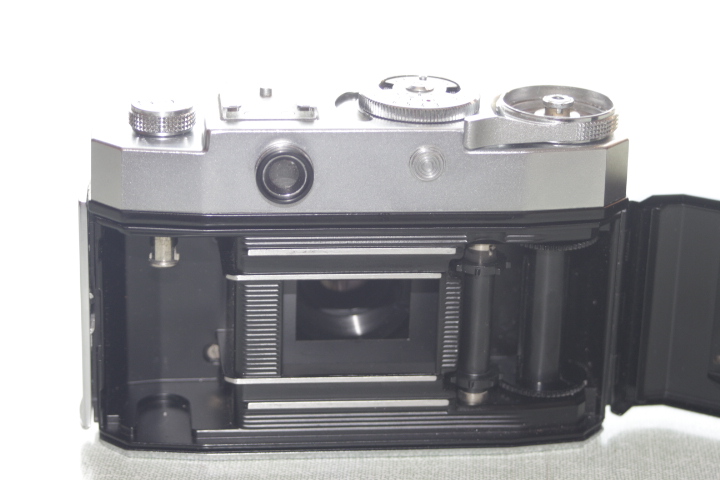
The back opens by pulling down a small catch on the lower right-hand edge. The back is hinged and there is a single light seal - a piece of velvet right by the hinge. The back itself has the pressure plate and a tensioning roller that goes by the take-up spool. Around the film mask are two machined film guides - showing as bright lines in the photograph above. The pawl for the rewind mechanism can be raised to enable fitting a film cassette and then lowered to secure the cassette.

24-December 2013


I have now finished my test roll of film - Agfa Vista+ 200 ISO from Poundland (yes, £1.00 per roll!). As expected, the camera works well. The only awkward thing was setting the EV values on the shutter as the mechanism is rather stiff.  I definitely would not want it too loose but it would be nice for it to be a bit easier to alter. The frame counter is missing on this camera - I assume due to a botched repair by the previous owner. It does not affect the camera's functionality at all and got me the camera at a bargain price. Below are a selection of pictures from the test film.

Pottergate Arch, Lincoln


Fountain in Lincoln Arboretum


Rockabilly Buskers, Lincoln


Lincoln Shoppers getting ready for Xmas


Foreign Buskers, Lincoln


Friday, 28 June 2013

Ikonta 520

This is a medium format camera (i.e. takes 120 film) from Zeiss Ikon.  It is a half-frame camera - 6 x 4.5 cm negative - which is half of a standard 120 frame of 6 x 9 cm. The body serial  number tells me it was made in 1932.

Ikonta 520, front view
lens: Novar
focal length:  75mm
apertures: f/6.3 to f/32
focus range: 4'6" to infinity (that is the scale, actually about 4 feet)
lens fitting: fixed
shutter: Derval
speeds: 1/25, 1/50, 1/100, B, T
flash: n/a
film size: 120


The body is made from cast aluminium.  This body casting is shared between the Ikonta 520, Bob 510 and Nettar 515. It is quite hard to understand why Zeiss Ikon shared the body between three different camera lines instead of calling them all Ikonta (the oldest name) seeing as Bob, Ikonta and Nettar all come with a range of lenses and shutters and can be considered to be one range in effect if not in name.

So, this Ikonta.  It is an Ikonta 520 - more specifically, a 520E. The other variants are
520IT with a f4.5 Novar and a Telma shutter,
520F with a F3.5 Novar and a Compur Rapid shutter and
520L with a f3.5 Tessar and Compur Rapid shutter.

The lens is a Novar which is a triplet and performs surprisingly well once stopped down to f/8 or smaller.  Ikontas were also available with Tessars at a higher price and wider aperture Novars.  The Novar on this camera is quite a slow lens with a maximum aperture of f/6.3.  The focussing is front cell only, rather than the whole lens moving (giving not quite so good image quality) and the focussing scale is in feet indicating that the camera is an official import into the UK.

The shutter is an everset Derval (everset means it does not need cocking before firing as a Klio or Compur would).  This is a fairly crude (and so cheap) shutter with two blades only and only offers three speeds: 1/25, 1/50 and 1/100.  With a slow lens like this camera has, faster shutter speeds would have been superfluous, particularly with the slow, by modern standards, films available in the 1930s.

Detail of rim-set shutter adjuster on Derval shutter
The shutter is a dial set shutter which means that the speed adjustment is by a dial set above the shutter housing.  More modern shutters have a rim set adjuster which is a ring around the shutter housing.  This shutter does not have a V (=Vorlaufwerk) setting for delayed action and as is usual with cameras made before the late 1940s, there is no flash connection or synchronisation.

Ikonta 520, side view
As I mentioned, the maximum aperture is rather small at f/6.3 but the minimum aperture is surprisingly small - f/32 - so the range of exposures possible is still respectably large.

A standard photograph with this camera (as with the Bob 510 and Nettar 515) is in portrait format and in this orientation the shutter release is underneath the camera and is uncomfortable to use.  To take landscape pictures, the camera must be used on its side and the shutter release is on the side and easy to use.

The viewfinder is the cheap two frame style of viewfinder - a Newtonian finder.

This was an expensive camera in its day - according to Tubbs (Zeiss Ikon Cameras 1926 -39, published by Hove Camera Foto Books), it cost £4/10/0 new in the early 1930s and advertised by Zeiss Ikon in the British Journal Almanac for 1936 at £4/17/6.  That is £4.50 in new money but a week's wages for a working man would have been around £1/10/0 or £1.50. So this camera cost around a months income for a working man which is around £1,000 in today's money.

19/07/20123:  I have now finished my test film for this camera and the results are not good.  The lens is susceptible to flare (as I would expect on a lens from 1930 - coating of lenses had not been invented yet) and some of the flare is very strange, suggesting something other than ordinary flare - a glass defect, perhaps.

Blues festival in Lincoln Arboretum

One of our many buskers in Lincoln - very young but quite accomplished

Lincoln Corn Exchange in the Cornhill

Comparison between Ikonta 520, Bob 510 and Nettar 515:


These three cameras from Zeiss Ikon share the same aluminium casting for their bodies.  This makes them very similar cameras.  They all take 120 film and they all produce half-frame negatives of 6 x 4.5 cm.  The details, however, are different.  I shall give the differences between them one model at a time, starting with the oldest.

Ikonta 520
This camera was produced from 1931 and is using the old fashioned dial set shutter - the disc at the top with the word 'Derval' on it..  The adjuster for the aperture is at the bottom of the shutter housing and requires the user to turn the camera around so that the scale can be seen.  The lens is a Novar triplet lens.  There is also a leather hand strap on this camera and the catch to close the back is solid.


Bob 510
Next is the Bob 510 (sold in the UK as a Nettar 510).  This is a slightly later camera first produced in 1934 and has a more modern rim set shutter - the dial is now replaced with a ring around the shutter housing.  Shutter speeds and apertures are the same, but the aperture adjuster is now on top of the shutter housing, behind the speed selector.  This means that the user can adjust the aperture with the camera pointing at the subject.  Perhaps not a major advance  but will have been less frustrating to use.  The lens is now a Nettar rather than the Novar - still a triplet but a different design.  There is no hand strap on this camera and the catch for the back is less secure than on the Ikonta

Nettar 515
Last is the Nettar 515.  This is later again, 1937, and also has the rim set shutter.  The shutter is now a Klio (on non-Zeiss Ikon cameras known as Prontor) with more shutter speeds (up to 1/175 and a few slow speeds).  The aperture adjuster is still on top, behind the speed adjuster, and there is now a delay setting lever below the shutter housing.  As with the Ikonta, the lens is a Novar triplet.  This shutter requires cocking before use  and there is an ancillary shutter release button on the camera body.  There is also provision to fit an optional brilliant finder on this camera although mine does not have this.  This model also has no hand strap and it has the same catch as the Bob 510


All three together, oldest on the left, newest on the right.

Tuesday, 23 April 2013

Serial numbers to help with dating cameras.

This is information that I have collected over the last few years from a number of sources.  Some of those sources contradict each other so I have had to make decisions as to what I wish to keep.  I cannot guarantee its accuracy.

The date a lens or shutter is made is not always the date the camera was made.  Both lenses and shutters are made and sold to camera manufacturers in batches.  A camera made in one year may have a lens made the previous year.  I have at least one camera (Zeiss Ikon Icarette) when the shutter was made the year before the lens.  It is also possible that either the shutter or the lens is a later addition made by a repairer.

Here are the links to the files:

Voigtlander lenses

Schneider lenses

Compur shutters

Carl Zeiss lenses (East and West Germany included)

Olympus Trip

Wednesday, 20 March 2013

Zeiss Ikon Voigtlander Vitessa 100 SR

This camera outlines the dangers of buying online.  One is reliant on the written description given by the seller and a photo or two.  Unfortunately, it is just not possible to physically examine what you are buying.

In this case, the camera was described as 'good and clean' with the seller saying that they knew nothing about cameras and so could not comment on functionality.  That last should have been a red flag to me - anyone can press the shutter release and tell if anything happens or not.  Similarly, other controls either turn, press or not and any seller can report such.

This camera is missing the battery cover which is blindingly obvious on even a cursory examination of the underside of the camera.  Less obvious but still well visible is the loose leatherette on the top (not visible in the picture supplied on Ebay) which covers two holes from which the screws have been removed.  Clearly, someone has attempted to take this camera apart.  The seller?  Or did the seller buy it in this condition and try to pass their mistake on?  I cannot know which but a small honesty on the part of the seller would have saved me buying an unusable camera.

I could have taken this up with Ebay but the cost to me was less than £10.00 including postage so it is not a major issue.  I just do not like people being dishonest with me and they now have a negative feedback for their troubles.

As to the camera itself, there is much to admire.  This model is one of the last engineered German cameras - Leica excepted - before Japanese plastic took over the world.  I don't mean that in a derogatory way as Japanese plastic has much to recommend it if only in weight.

This camera is heavy and you are not going to forget that you are carrying it.  The three main controls are easy to find by feel - at this time Zeiss Ikon had taken to putting plastic tabs on the focussing ring, aperture ring and shutter speed ring.

The aperture ring is between the other two and has the widest tabs.  The shutter speed ring is closest to the camera body and has tabs that extend to less than half the circumference of the ring.  The focussing ring is at the front and has only a small tab at the bottom below the lens.

This set-up means that it is easy to find the correct control by feel - the values are repeated in the viewfinder with a rangefinder spot in the centre for focussing.

The rangefinder is the worst aspect of this camera - the rangefinder spot is fairly small and quite faint.  It works fine but could be easier to use.

Wednesday, 15 August 2012

Light (or exposure) meters


Light meters (which are also called exposure meters) are a modern invention and early photographers had to guess their exposures and rely on experience to get it right.  An early system used to make guessing easier was to use the Sunny 16 rule which says:
  • "On a sunny day set aperture to f16 and shutter speed to the [reciprocal of the] ISO film speed [or ISO setting] for a subject in direct sunlight." 
 (from Bernhard J. Suess (2003). Mastering Black-and-White Photography, Allworth Communications. ISBN 1-58115-306-6)  So, if you are using Ilford FP4 film, which is ISO 125, on a sunny day you set the aperture to f16 and the shutter speed to 1/125 seconds.  This will generally give you a usable picture even if not a perfectly exposed one.  You do need to be aware that the amount of light on a sunny beach will be more than the amount of light in a sunny field - entirely due to the amount of reflected light.  You can easily adjust either the aperture or the shutter speed to compensate.  You also need to be aware that the amount of light present on a sunny day depends on how close to the equator you are.  A photographer in Norway using the Sunny 16 rule will get a very different result than a photographer in Nigeria would.  I have been trying this Sunny 16 rule out in Lincoln this week and in the middle of the day it produced the same exposure as my Ikophot exposure meter suggested.  By four in the afternoon, the Sunny 16 rule was a whole stop out.

A better system was the extinction meter.  This used a piece of translucent celluloid that was painted black apart from a series of grey numbers.  Each number was printed in a darker shade of grey than the last number.  So, in my Braun Paxette, the number 1 is nearly white and the number 16 is nearly black.  In use, the user looks through the extinction meter and notes the darkest number that is visible.  This number is then looked up in an exposure table to get suitable aperture and shutter speeds.  This picture of my Braun Paxette show one of these tables.  It is set up for 50 ASA (ISO) film and tells you to halve the exposure for 100 ASA film and double it for 12 ASA film (films were much slower then than we are used to now).  This chart refers to 'diaphragm' rather than 'aperture' but it is the same thing.


Extinction meter table on my Braun Paxette

These, although simple and not able to go wrong, had their drawbacks.  They depended on the quality of the eye sight of the user and that is very variable.

The next development was the electronic light meter.  Initially, these had a cell made from selenium that produced a small electrical voltage on exposure to light.  This voltage was then used to move a needle across a scale.  This needle would then point to an arbitrary number that has to be set on a scale.  The scale then indicates a range of appropriate aperture and shutter speeds.  It is tempting to think of these as EV numbers but they are not - at least are not on the three light meters I own.  These worked very well in reasonable light but were poor performers in poor light.  These fell out of fashion and were replaced by CdS meters.  The advantage of selenium meters is that they do not need a battery to work.  A big disadvantage is that they lose sensitivity with time.  Towards the end of their useful life they give a low reading which will eventually cause over-exposed photographs.  For this reason, some people will not use old selenium meters but my old (fifty years old, plus) meters all agree with my modern light meters.

 I suspect that the rate of deterioration depends on how the meter has been stored over the years.  If the meter is in the dark inside a case apart from when actually taking a reading, the deterioration doesn't seem to matter over a period of sixty or so years.

The next development was the CdS meter (Cadmium Sulphide).  These do not produce a voltage on exposure to light but act as a resistor that changes its resistance to electricity on exposure to light.  These always need a battery to work to provide the voltage.  Most modern light meters work this way.  These work in much lower light levels and do not significantly deteriorate with time.  The draw back with these is that battery technology changes and it can be hard (or impossible) to find batteries for older CdS meters.  In particular, mercury batteries are no longer made and the modern equivalents produce a different voltage which alters the accuracy of the meters.

A lot of meters from the 1950s used what are called Exposure Values (EV).  The idea is that you set your shutter to the indicated EV and this sets a combination of shutter speed and aperture.  As you then alter the aperture, the shutter speed will alter in unison - and vice versa.  I like the system but many people do not.

Here is a table of EVs and their associated aperture/shutter speeds:
 
Table 1. Exposure times, in seconds or minutes (m), for various exposure values and f-numbers
EV f-number
1 1.4 2 2.8 4 5.6 8 11 16 22
−6 60 2 m 4 m 8 m 16 m 32 m 64 m 128 m 256 m 512 m
−5 30 60 2 m 4 m 8 m 16 m 32 m 64 m 128 m 256 m
−4 15 30 60 2 m 4 m 8 m 16 m 32 m 64 m 128 m
−3 8 15 30 60 2 m 4 m 8 m 16 m 32 m 64 m
−2 4 8 15 30 60 2 m 4 m 8 m 16 m 32 m
−1 2 4 8 15 30 60 2 m 4 m 8 m 16 m
0 1 2 4 8 15 30 60 2 m 4 m 8 m
1 1/2 1 2 4 8 15 30 60 2 m 4 m
2 1/4 1/2 1 2 4 8 15 30 60 2 m
3 1/8 1/4 1/2 1 2 4 8 15 30 60
4 1/15 1/8 1/4 1/2 1 2 4 8 15 30
5 1/30 1/15 1/8 1/4 1/2 1 2 4 8 15
6 1/60 1/30 1/15 1/8 1/4 1/2 1 2 4 8
7 1/125 1/60 1/30 1/15 1/8 1/4 1/2 1 2 4
8 1/250 1/125 1/60 1/30 1/15 1/8 1/4 1/2 1 2
9 1/500 1/250 1/125 1/60 1/30 1/15 1/8 1/4 1/2 1
10 1/1000 1/500 1/250 1/125 1/60 1/30 1/15 1/8 1/4 1/2
11 1/2000 1/1000 1/500 1/250 1/125 1/60 1/30 1/15 1/8 1/4
12 1/4000 1/2000 1/1000 1/500 1/250 1/125 1/60 1/30 1/15 1/8
13 1/8000 1/4000 1/2000 1/1000 1/500 1/250 1/125 1/60 1/30 1/15
14
1/8000 1/4000 1/2000 1/1000 1/500 1/250 1/125 1/60 1/30
15

1/8000 1/4000 1/2000 1/1000 1/500 1/250 1/125 1/60
16


1/8000 1/4000 1/2000 1/1000 1/500 1/250 1/125
17


1/8000 1/4000 1/2000 1/1000 1/500 1/250
18


1/8000 1/4000 1/2000 1/1000 1/500
19


1/8000 1/4000 1/2000 1/1000
20


1/8000 1/4000 1/2000
21


1/8000 1/4000
EV 1 1.4 2 2.8 4 5.6 8 11 16 22
f-number

To my light meters:

I have four old meters, each of the selenium type.  They are a Weston Master III, a Leningrad 4, a Ikophot and a Bewi Automat.  The Weston does not work - I tried to adjust the zero setting and managed to wreck the meter.  The blame for this lies entirely with me, not Weston’s design or manufacturing standards.

First, the Weston.

This is a Weston Master III

Weston Master III
It is the most complicated meter of the three I have - presumably it will do more than the other two.  The draw backs for me is firstly there is no ASA or DIN setting, it uses instead Weston values which are their own proprietary system. As films do not come with a Weston speed marked on them, it makes it unnecessarily difficult to use.  Secondly, I find the plethora of black and white marking difficult to distinguish.  As I mentioned earlier, I managed to break this meter, so my complaints about it are moot.

Secondly, Leningrad 4:
Leningrad 4
This is much simpler in layout than the Weston and much easier to use.  The needle points at red numbers, these red numbers are then set against a large pointer on the other end of the meter and the aperture/shutter speed combination are read off a black and white scale.  The film speed can be set in either ASA or DIN and will work with modern films with ISO speeds as they are the same as ASA.  A note of caution:  these red numbers are NOT Exposure Values - they seem to be arbitrary numbers and are different to the equivalent numbers on the Ikophot meter.

Thirdly, Zeiss Ikon Ikophot:
Zeiss Ikon Ikophot
This mirrors the Leningrad in as much as the meter needle points to red numbers and the red numbers are then aligned against a red pointer.  The aperture/shutter speed combination is then read off the scale - aperture in black and shutter speed in white on red.  Again, film speed can be set in either ASA or DIN.  A note of caution:  these red numbers are Exposure Values but only for 50 ASA/18 DIN film (I expect 50 ASA/18 DIN was seen as standard by Zeiss Ikon).  It is possible to use them directly on cameras with a EV scale on the shutter, but you will need to adjust for the speed of the film you are using.  This is simple enough - for 100 ASA, 21 DIN film, subtract 1 from the EV; for 200 ASA, 24 DIN film subtract 2 from the EV and for 400 ASA, 27 DIN film, subtract 3 from the EV.

The DIN/ASA scales on this meter are a bit unique.  DIN 21 SHOULD be ASA 100, but it is ASA 80.   I use the DIN exclusively and that works just fine.  I suspect using the ASA scale would also be fine as the difference between 80 and 100 is fairly small (1/3 of a stop).  As DIN is a German standard and Zeiss Ikon are a German firm, I would expect them to get DIN right.

Not cheap - it cost £10/13/5 in 1957 - which was just over an average man's weekly wage (so about £500 in 2013 values).

This is the meter I most often use as it is nicely made, feels good in the hand and produces satisfactory results.  A scanned copy of the Ikophot manual is available for download as is a scanned copy of Zeiss Ikon's 1930s exposure guide.

Lastly, my Bertram Bewi Automat.

Bertram Bewi Automat
This is a German meter (made in West Germany).  Bertram have been making light meters since 1928 . This meter works differently from the meters above.  For one thing, it has a digital read-out rather than an analogue needle pointing to a scale. 

The meter is rather larger than is usual for analogue meter - it measures 90 x 65 x 25 mm not including the activating button.  It is encased in ivory plastic.

 The only control is a ring to set the film speed.  This is calibrated in ranges. For instance, the DIN setting is a range of three numbers - 11-13, 14-16, 17-19, 20-22, 23-25.  That is one stop difference between each range.  Given the exposure latitude of film that is plenty accurate enough.  There are also ranges for ASA and Weston (ASA is the same as ISO and Weston is a defunct film speed system devised by the makers of the Weston series of exposure meters.

Using the meter is also different to analogue meters.  If you point this meter at the scene you intend to photograph, nothing happens.  You need to point the meter, depress the activating button for about three seconds and release.  Once you have done this, the shutter speed scale lines itself up with the aperture scale and you can read off suitable combinations of aperture and shutter speed.

The read out also has exposure values indicated - under L on the aperture scale.  These are adjusted for film speed and can be set directly on an EV enabled shutter.