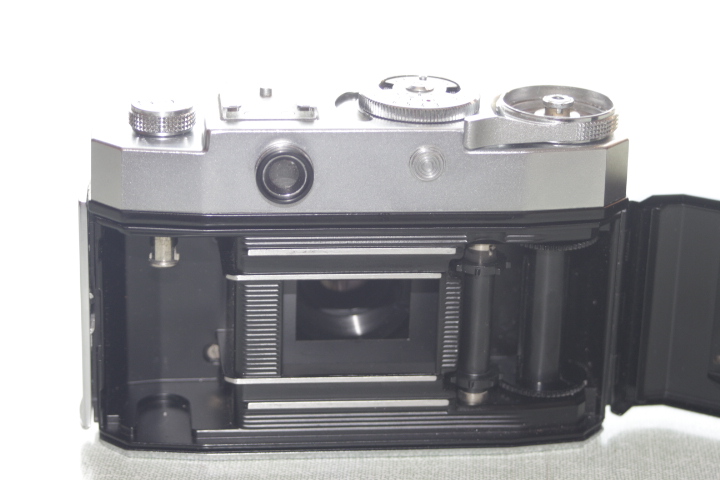
This is a folding camera from Zeiss Ikon based on the medium format Ikonta series. This camera gave rise to two lines of cameras in the mid-50s - the Contina and the Contessa cameras. I have two of these, an early Ikonta 35 late 1940s to very early 1950s and a slightly updated version. First I am going to describe the early/original version and then briefly the changes on the updated version.
 |
| Ikonta 35 ready for use |
lens: Novar
focal length: 45 mm
apertures: f/3.5 to f/22
focus range: 0.8 m to infinity
lens fitting: fixed
shutter: Prontor S
speeds: 1, 1/2, 1/5, 1/10, 1/25, 1/50, 1/100, 1/300
flash: PC connector
film size: 35 mm
It measures 120 mm by 75 mm by 40 mm (closed), 80 mm (open) and weighs 440 g.
 |
| Ikonta 35 with its carry case |
The lens door opens downwards which leaves plenty of room at the sides for the fingers of both hands. On my Ikonta 520 (120 film camera) - and my Nettar folders - the lens door is released by pressing a button on the top and the lens door snaps open on springs and pulls the lens forward to its operating position. On this camera, you slide a button on the top of the lens door and pull the door down by hand. When the door is fully open you have to give it a firm press to click it into place.
 |
| Ikonta 35 - folded |
The lens is a Novar made by Rodenstock, which is a triplet. During WWII, bombing of Dresden destroyed Carl Zeiss's lens factory and after German partition West German Zeiss set up new lens making facilities in Oberkochen. It was a long time before they could make enough lenses and so used lenses by Rodenstock and Schneider. Novar lenses are usual excellent if stopped down to f/8 or so - which is what I generally do for all lenses - so I am expecting this lens to be a good performer. Its maximum aperture is f/3.5 which is not spectacular but plenty wide enough for most practical purposes. The focal length is 4.5 cm - this dates the lens as usual practice in the first half of the 20th century was to quote focal length in cm and in the second half of the 20th century to quote in mm - so, the last of pre-war stock or very early post-war production. The serial number of the camera is followed by an asterisk which I am told probably means the camera was partially made from pre-WWII components so I expect the lens is a pre-WWII lens - the last of Zeiss Ikon's stock? 45 mm is 'normal' for 35 mm film so this lens will render scenes much as human eyes see them.
--------------------------------------------------------------------------------------------------------------------------------
Blog copyright by John Margetts, 2014
---------------------------------------------------------------------------------------------------------------------------------
--------------------------------------------------------------------------------------------------------------------------------
Blog copyright by John Margetts, 2014
---------------------------------------------------------------------------------------------------------------------------------
 |
| Ikonta 35 - right hand view |
The shutter is a Prontor S - pre-war Zeiss Ikon used their own Klio name for Prontor II and Prontor S shutters - they seem to have abandoned this after the war. The S signifies the shutter is synchronised for flash but there is no means of selecting between X or M synch (this was introduced on later Prontor S shutters - see below - and was standard on the Prontor SV and Prontor SVS shutters). At this age, the shutter needs to be cocked by hand. This is different on this camera to any other shutter that I have come across. You pull the cocking lever anti-clockwise and the lever pulls a second lever across - the first level returning to its rest position.
 |
| Ikonta 35 - left hand view |
The Prontor S shutter has a top speed or 1/300 which I generally find to be fast enough. My usual films are either 100 ISO or 200 ISO and this allows me to use f/8 or f/11 in good light year round. The shutter has a self-timer (Vorlaufwerk) which we are always told not to use on old cameras. On this camera, the self-timer is very hesitant and took over a minute to fire the shutter - design time is eight seconds! As is usual with old cameras, the slow shutter speeds are way off and unusable - 1/5 seconds is about 5 seconds. On the other hand, I use these old cameras hand-held and so my longest exposure will be 1/50. the slow speeds and fast speeds use different mechanisms within the shutter - 1/50, 1/100 and 1/300 are in the right general area, judging by ear and I shall be surprised if they are not usable. Half a stop either way is well within the latitude of film.
The shutter release is a strange affair. It is not the lever provided by the shutter makers, nor is it a body release. It is a secondary lever attached to the shutter barrel at the top. It is marginally better than the primary release but not as good as the body releases that Zeiss Ikon were using in the late 1930s. Actually, it is very similar in position and action to the shutter release on the Tenax I of 1939 (both cameras designed by Hubert Nerwin). There is also the ubiquitous cable release socket.
The adjuster for the aperture is non-standard as well. It is a toothed wheel on the left side of the shutter housing which is not obvious without the manual (I do not have the manual) and took me a few moments to work out.
 |
| Ikonta 35 - top plate |
The top plate is very uncluttered. In the centre is a raised part housing the (very small) viewfinder. It measures 9 mm by 6 mm (the same as on my Voigtlander 35mm folders of the same date) and is the weakest part of the camera. This is a reverse Galilean finder ('reverse' because it is like looking through a telescope from the wrong end giving a reduced size view).
On the left-hand end is a reminder for film type - daylight colour, artificial light colour and monochrome. On the right-hand end is a tripod boss. This is the only time I have seen a tripod boss on the top of a camera and means that the camera would be upside down when fitted to a tripod. It would be just about possible to fire the shutter with the release lever but I suspect that anyone who put this camera on a tripod would have used a cable release. The MK II Ikonta 35 had the tripod boss on the lens door - a very big improvement! At either end of the top plate is a rectangular strap lug.
 |
| Ikonta 35 - bottom plate |
The bottom plate has the film advance on left-hand end - this is a knob. On the right-hand end is the rewind knob and in the centre of the base plate is a frame counter. In the centre of the film advance knob is a button to allow the take-up spool to turn backwards for rewinding the film.
Ikonta 35 in use.
I have run a roll of film through this camera now. It is a nice camera to use (I know 'nice' is not a good word to use here) with no design problems getting in the way. Using it is very similar to using a folding Voigtlander Vito camera. The shutter release falls naturally (for a right-handed person) under the index finger of the right hand and the ring finger on the left hand can easily turn the film advance.
My main problem with using this camera was, as with all cameras of this age, the small viewfinder. I have developed a technique now of deciding the framing of the picture without looking through the viewfinder, taking my glasses off and positioning dominant parts of the picture without the view being in focus. This actually works quite well.
The camera has a fault with the film advance mechanism - possibly two related faults. Sometimes when I try to advance the film, the advance knob will not turn. To get this to turn, I have to put my thumb over the lens (to prevent any light getting in), cock the shutter and release it a second time. This was necessary four times in a 24 exposure roll of film. This suggests that the double exposure prevention mechanism fails to release the film advance on the first firing of the shutter. The second fault is that sometimes the film will advance two frames instead of stopping at one frame - this happened a couple of times wasting two frames. Apart from these two intermittent faults the camera behaved perfectly. There are no light leaks either from the back or from the bellows, exposure is fine as is focus.
Before sharing the results of the test film, I am going to briefly discuss the changes made between the original design as described above and the next version.
There are a couple of minor changes between the original version and the next version. The most obvious is the addition of an accessory shoe above the viewfinder, on the top plate. This is a 'cold shoe' - there are no electrical contacts for a flash gun yet.
The other change is the use of a more modern Prontor S shutter. On the original Ikonta 35, the Prontor S shutter was synched for flash but there was no means of selecting the synch delay. There was also a self-timer lever. This updated version of the Ikonta 35 has an improved Prontor S that offers either X, M or F flash synch. For X synch you set the selector lever to X (or red) - the flash will fire as soon as the shutter is open. For M or F synch, it is more complicated. First, you set the flash synch selector to yellow. This will give you synch for F flash bulbs (the flash is fired 5 milliseconds before the shutter is fully open to allow the brightness to build up). For M synch, you set the flash synch selector to yellow and the self-timer to M which will fire the flash 20 milliseconds before the shutter is fully open, again to allow the brightness to build up. To use the self-timer actually as a self-timer, the flash synch selector must be set to X/red
There are also a couple of very minor changes - the shutter assembly no longer has a cable release socket so Zeiss Ikon has added one at the top on the other side to the shutter release lever. The release lever is now about twice the diameter of the original one. The last change is that the focal length of the lens is now quoted as 45 mm rather than 4.5 cm.
There are also changes to the leather case. It is now an every ready type case which has a secondary film advance on the underside that meshes with the film advance on the camera. this means the camera can now be used without removing it from its case. There is also a tripod boss on the underside of the case which means it is no longer necessary to have the camera upside-down to attach it to a tripod.
New improved version.
There are a couple of minor changes between the original version and the next version. The most obvious is the addition of an accessory shoe above the viewfinder, on the top plate. This is a 'cold shoe' - there are no electrical contacts for a flash gun yet.
The other change is the use of a more modern Prontor S shutter. On the original Ikonta 35, the Prontor S shutter was synched for flash but there was no means of selecting the synch delay. There was also a self-timer lever. This updated version of the Ikonta 35 has an improved Prontor S that offers either X, M or F flash synch. For X synch you set the selector lever to X (or red) - the flash will fire as soon as the shutter is open. For M or F synch, it is more complicated. First, you set the flash synch selector to yellow. This will give you synch for F flash bulbs (the flash is fired 5 milliseconds before the shutter is fully open to allow the brightness to build up). For M synch, you set the flash synch selector to yellow and the self-timer to M which will fire the flash 20 milliseconds before the shutter is fully open, again to allow the brightness to build up. To use the self-timer actually as a self-timer, the flash synch selector must be set to X/red
There are also a couple of very minor changes - the shutter assembly no longer has a cable release socket so Zeiss Ikon has added one at the top on the other side to the shutter release lever. The release lever is now about twice the diameter of the original one. The last change is that the focal length of the lens is now quoted as 45 mm rather than 4.5 cm.
There are also changes to the leather case. It is now an every ready type case which has a secondary film advance on the underside that meshes with the film advance on the camera. this means the camera can now be used without removing it from its case. There is also a tripod boss on the underside of the case which means it is no longer necessary to have the camera upside-down to attach it to a tripod.
The photographs ( from the original version):
 |
| St John the Baptist, Lincoln |
 |
| Orthodox church, Lincoln |
 |
| St Mary's Church, Frampton, Lincolnshire |
 |
| St Peter & St Paul, Kirton, Lincolnshire |
 |
| St Peter & St Paul, Kirton |
 |
| St Peter & St Paul, Kirton |
 |
| St John the Baptist, Lincoln |
 |
| St Mary le Wigford, Lincoln |
 |
| St Benedict, Lincoln |
 |
| St Benedict, Lincoln |
 |
| St Mary's, Frampton |
 |
| Gravestone, St Mary's, Frampton |
 |
| St Mary's |
 |
| St Mary's |
 |
| St Peter & St Paul, Kirton |