Showing posts with label prontor svs. Show all posts

Tuesday, 27 January 2015

Balda Super Baldina


This is my second Balda Baldina. The first is a folding Baldina from the 1930s. The Super in the name indicates that it has a coupled rangefinder. This new Baldina is from the 1950s and is not a folder but nods in that direction with a collapsible lens. This is fairly effective - it reduces the thickness of the camera by two cm which means it easily fits in a jacket pocket. The camera leatherette is stamped "Made in Germany" and the focus scale is in feet, indicating that this is an official import into the UK.

Balda Super Baldina (C) John Margetts
The top plate is as you might expect from a mid-1950s German camera. In the middle is a large hump containing the viewfinder and rangefinder. This has both the viewfinder and rangefinder eyepieces in one - my Franka Solida of the same period has separate viewfinder and rangefinder eyepieces which makes using the camera awkward. On the top of the viewfinder/rangefinder hump is an accessory shoe - no electrical contacts at this date, so a cold shoe.

Balda Super Baldina top plate.
On the left of this hump is the rewind knob. This is surrounded by a film type reminder. There are four options for this - film speed in DIN, film speed in ASA, colour positive or colour negative.  To the right of the hump is the film advance. This is a lever with a large, coarsely milled thumb post.This moves through 180 degrees to advance one frame which is easily done in one throw of the thumb. At the base of this is the frame counter. This counts up from one to thirty six. In front of the film advance is the shutter release. This is a fair-sized button, threaded for a standard cable release. I have a slight niggle here as the shutter release button is slightly below the level of the film advance level which makes finding the release button by feel less obvious than it could be.

On either end of the top plate is a lug for attaching a strap - this is far more important than camera manufacturers seem to understand.

With lens collapsed.
With lens extended.
The front of the camera is dominated by the collapsible shutter/lens housing. This is quite well organised with the parts easy to get at. The shutter/lens housing is mounted on a square stainless steel bezel. On the top right of this bezel is a button to release the collapsible housing. When pressed, the shutter/lens housing pops out with a satisfying clunk.

Around the base of the housing is the focusing ring. This has a large knob on it below the lens which makes focusing at eye-level with the rangefinder very easy. Between the focusing ring and the lens release button is a depth of field scale - something regrettably missing from more modern cameras.

The next control on this housing is the aperture selector. This varies between f/3.5 and f/16. There are no click-stops so intermediate positions can be selected. Outside of this is the shutter speed selector - this is a conventional ring. The shutter is a Prontor SVS (a Compur Rapid was also available) so shutter speeds are from one second to 1/300 seconds.  The 'S' in the shutter name tells us it is synchronised for flash - two 'S's tells us it can be synchronised for M (bulbs) or X (electronic) flash guns. The V stands for Vorlaufwerk which indicates a self-timer is available.  There is a PC (Prontor Compur) socket set into this housing for attaching a flash gun.

Balda Super Baldina rear/internal view.
The shutter controls have Happy Snapper settings - f/8 is in red and there is a red dot at nine feet and a green dot at around thirty feet. The red dot is intended for portraits and will give you a focus range of six feet to twelve feet - suitable for a head-and-shoulders shot or a small group. The green dot is for landscaped and is the hyperfocal distance at an aperture of f/8 - it gives a focal range of 12/13 feet to infinity.

The focusing knob moves the whole shutter/lens assembly. this means that the whole lens moves to focus rather than just the front element. This means that the lens always performs at its optimum - whatever that optimum might be. The lens is a Baldinar which is made for Balda rather than by them. There were a host of lens-makers in Germany making lenses for camera manufacturers and this could have come from any of them or, indeed, several of them. The lens is a triplet (three pieces of glass) which is unlikely to perform well with a wide aperture. my experience of German triplets is that they perform very well once stopped down to f/8 or smaller. At the date this camera was made, the lens will be coated - and there is the tell-tale blue sheen to the lens to confirm this.

The inside of the lens front is threaded for filters. I make it to be 35mm diameter but that could be plus or minus a millimetre or so.

On the rear of the top plate, to the left of the viewfinder eyepiece, is a large screw. I suspect this is to adjust the rangefinder but as the rangefinder is working fine I am not going to fiddle with it to find out for sure. The rangefinder works as they usually do. There is a central spot that needs to be aligned to the main image by moving the focusing knob on the front of the camera. This spot is clear, even in poor light, which makes the rangefinder useful in practice - not something I find you can safely assume. One quirk here is that the rangefinder spot is pale blue in colour rather than the more usual yellow but that does not affect its usefulness.

Thursday, 5 September 2013

Contina IIa

Zeiss Ikon's Contina camera was a long lived and varied series of cameras.  The series started as the Ikonta 35 which was a post-war version of the 120 format Ikonta adapted to take 35 mm film.  This camera became two series of cameras - the Contessa and the Contina; the first Contessas and Continas were folding cameras. The Contessa version was more up-market than the Contina version. I have already written about one of the Contessa line - the Contessa LKE. The Contessa line have better lenses (Tessars) and coupled light meters and rangefinders. The Contina range have cheaper lenses (Novar, Novicar and Pantar) and the light meters, where present, are uncoupled. I have also written about the Contina line elsewhere - the Contina Ic.

lens: Novicar
focal length:  45mm
apertures: f2.8 to f22
focus range: 1m to infinity
lens fitting: fixed
shutter: Prontor-SVS
speeds: 1 second to 1/300 seconds
flash: PC connector
film size: 35mm

Contina IIa - front view, meter window closed
To make identifying and placing Contina cameras as difficult as possible, the Contina series split into two lines of cameras simultaneously.  The original Contina folding camera  became the Contina II folding camera with a light meter and then a series of derivatives. That original Contina folding camera, at the same time, became the Contina I rigid camera - no light meter or rangefinder - and then a series of derivatives.
Front view - meter window open

So, at any one time after 1953 there were two different Continas available, both just designated Contina. I have been referring to Contina I, Contina II, Contina Ic, Contina IIa but I don't think those were names offered by Zeiss Ikon, rather us collectors use them to make sense of the mish-mash of models.

Daniel Jiménez has produced a 'family tree' of the Contina series which he has given me permission to use here:

Copyright Daniel Jiménez
Daniel has a useful camera blog which can be found in an English version here. He also has a much larger Spanish version here.

This camera - is a Contina IIa. It is derived from the Contina II which was a folding camera but this version does not fold - that is, it is rigid. It is a compact and solid camera measuring 120 x 65 x 85 mm and weighs 567g. It offers a built-in but uncoupled light meter and an EV enabled shutter. It was not a cheap camera - it cost £43/15/1 in 1957 (in old money, or £43.76 in new money) which, given the average male wage in 1957 was £9.00 means this camera cost the equivalent of £2,500 in 2013 values. The version with a Novar lens only cost £36/12/7.

The top plate of the camera has a number of  items on it. On the left is a small rewind knob. I prefer these to the small folding cranks that became ubiquitous in the 1960s. When you first turn the rewind knob, it raises itself by one cm. This is above the height of the centre of the top plate and makes it easier to hold and turn.

rear and top view
Next to the rewind knob is an accessory shoe. At the time that this camera was made (1956/58) this was more likely to be used for a separate rangefinder than a flashgun. There are no electrical contacts in the accessory shoe so it is a cold shoe.

Next to the accessory shoe is the light meter window and the light meter control knob. Visible in the window is a needle connected to the light meter. The brighter the light, the more this needle moves towards the rear of the camera. Also in this window is a white circle which moves in response to the user moving the control knob. When the white circle is over the needle, the correct exposure can be read off the scale around the control knob. This is mostly in EV values - more later. In the centre of the control knob is the setting for the film speed. This camera was made in 1956/8 and uses the film speed standards in place at that time. A few years later (1960), the American Standards Association (ASA) revisited their film speed standard to produce the later ASA standard now known as ISO. The German DIN system remained unchanged so on this camera 21 DIN = 40 ASA rather than the later standard of 21 DIN = 100 ASA (ISO) - I always use the DIN standard with old cameras to make sure I do not get it wrong.

On the far right of the top plate is the film advance lever. This moves through about 200 degrees to advance the film and cock the shutter. The lever is all metal and only curves a very slight amount which I find makes it uncomfortable to use. In the centre of the film advance lever should be the frame counter. I can make no comment about this as a prior owner has removed it. Looking at the state of the metal that is left, I suspect a very amateurish attempt at a repair.

The front of the camera has four items - meter window, viewfinder window, shutter housing and flash PC connector. The meter window contains a two cm by one cm lens covering a selenium photoelectric cell.  This does not need any batteries, which I always reckon to be a good thing.  Most camera electrics from the 1960s to 1980s use mercury cells which are now illegal in just about every country there is. This window has a hinged cover - to open it, you lightly press the right-hand end (as the camera is to your eye). Selenium meters get a poor press as the photoelectric cell will deteriorate with time. However, if the cell is kept in the dark it only deteriorates very slowly, so this cell being covered, it has not yet (in 57 years) deteriorated enough to worry about. This is a single scale meter - an earlier version of the Contina IIa had a dual scale meter with a small window in the hinged cover.

Next to the meter window is the viewfinder window. This has quite a small eyepiece and a plain view with no bright lines. I find I cannot use it while wearing my glasses.  The Contina Ic, which I also own, has a much larger eyepiece - this was made just a few years later in the early 1960s.

In the centre of the front is a square chrome bezel containing the shutter.  This is a Prontor-SVS from Gauthier. This works on the EV system.  The light meter gives you an EV value from between  three and eighteen and you transfer this number to the shutter - you have to press a small tab on the shutter housing to get the EV ring to turn. Each EV number gives you a small range of shutter speed and aperture settings.  If you turn the EV setting ring without pressing the small tab, different speed/aperture combinations will present themselves to the mark at the top of the housing. For very low light levels, the shutter speeds are in green - you cannot set these, but you can read them.  To use them, turn the control ring on the shutter housing to B and read off a speed next to the aperture you want to use.  You then need to time the exposure yourself - the speeds are from four seconds to sixty seconds and you can count this quite accurately without a watch.

The lens is a Novicar lens (a Novar lens was also available) which I have found to be excellent if stopped down to f5.6 or f8. It is threaded for 27mm filters.  Maximum aperture is f2.8 and its focal length is 45 mm. Focusing is from about three feet to infinity (one metre to infinity). The throw of the focusing is only about 120 degrees, so very accurate focusing is not possible, but with no rangefinder, this camera was always going to rely on depth of field.

On the lower right of the shutter bezel (looking at the camera) is the flash PC (Prontor-Compur) connector.  This is the only means of connecting a flashgun. On the side of the shutter housing there is a selector for M or X - Magnesium or Xenon  - flash. M is for flash bulbs and X for electronic flash. With M, the flash is fired slightly before the shutter opens to allow the burning of the flash bulb to reach its maximum while the shutter is fully open. With X, the flash is fired as the shutter blades are fully open as electronic flash does not require time to reach its maximum intensity. This selector also has a V setting. This means Vorlaufwerk and is German for self timer. Moving the selector to this position causes an eight second delay between pressing the shutter release and the shutter firing. It is never a good idea to try this facility on an old camera as it might well cause the shutter to stop working permanently.
Rear/internal view

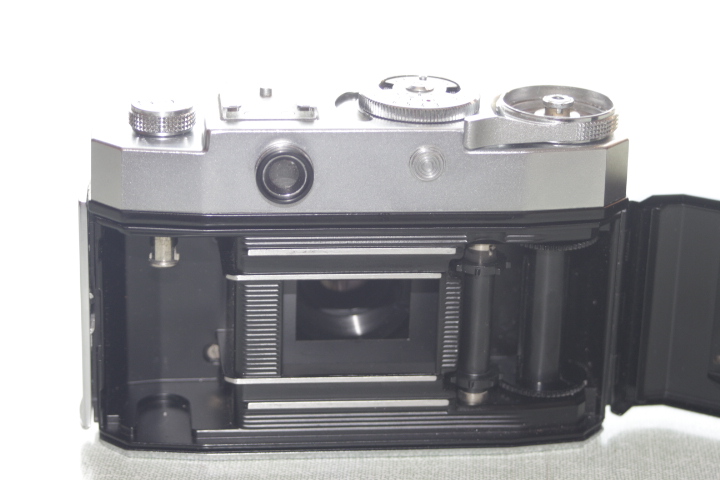
The back opens by pulling down a small catch on the lower right-hand edge. The back is hinged and there is a single light seal - a piece of velvet right by the hinge. The back itself has the pressure plate and a tensioning roller that goes by the take-up spool. Around the film mask are two machined film guides - showing as bright lines in the photograph above. The pawl for the rewind mechanism can be raised to enable fitting a film cassette and then lowered to secure the cassette.

24-December 2013


I have now finished my test roll of film - Agfa Vista+ 200 ISO from Poundland (yes, £1.00 per roll!). As expected, the camera works well. The only awkward thing was setting the EV values on the shutter as the mechanism is rather stiff.  I definitely would not want it too loose but it would be nice for it to be a bit easier to alter. The frame counter is missing on this camera - I assume due to a botched repair by the previous owner. It does not affect the camera's functionality at all and got me the camera at a bargain price. Below are a selection of pictures from the test film.

Pottergate Arch, Lincoln


Fountain in Lincoln Arboretum


Rockabilly Buskers, Lincoln


Lincoln Shoppers getting ready for Xmas


Foreign Buskers, Lincoln


Saturday, 2 March 2013

Braun Paxette IIM

Braun Paxette II M
lens: Steinheil Munchen Cassarit
focal length:  45 mm
apertures: 2.8 to 16
focus range: 1 m to infinity
lens fitting: 39 mm (non-Leica)
shutter: Prontor SVS
speeds: 1, 2, 5, 10, 25, 50, 100, 300
flash: m, x, v  PC connector
film size: 35 mm

Braun made collecting their camera tedious.  They didn't bother putting model names on their cameras.  OK, this says "Paxette" but that is a range of cameras not a specific Braun camera.  My other Braun camera also says 'Paxette' and they are clearly different models.

The basic body of the design is the same but this current model has no extinction meter (no great loss) but does have a rangefinder (no great gain) and an exchangeable lens.

The film advance is a lever advance but it really is just a lever stuck on a knob winder.  It requires two full strokes to advance the film one frame - a bit awkward and not really any better than a simple knob would be.  I suspect the main advantage of adding the lever was a marketing one rather than a practical one.  The second travel of the film advance cocks the shutter and reduces the film counter by one (this camera counts down from the length of the film to zero).

Film rewind is still a knob and I prefer this to the small cranks that became popular through the 1960-s, 70s and 80s.  If a maker fits a rewind crank then it should be a sizeable one as on a Zeiss Ikon Contessa LKE

This camera does not have the extinction meter that my other Paxette has.  In its place is an uncoupled rangefinder.  This is adjusted by a small vertical wheel which works well enough but is a bit on the small side for my fingers.  As the rangefinder is uncoupled it is necessary to read the distance from a small window by the adjustment wheel and then transfer this reading to the focussing ring on the lens.  Guessing the distance is easier with a bit of practice and just as accurate with the lens stopped down to f8 or so.  The rangefinder and focus ring are both marked in meters which is unusual in an official import from Germany - the back of the camera is clearly marked "Made in Germany" so it is an official import.  My other Paxette has the focus ring marked in feet, so it is not a case of Braun not having the resources to produce market dependant versions.

The shutter is a Prontor SVS which was very much the standard shutter with serious cameras at this time. (1953 or so).  Compur shutters have something of a better name but I have never had a Prontor shutter of fifty or sixty years age be anything but excellent.

Shutter speeds seem to be about right.  I have no way of testing them but the manufacturers were happy with +/- 20% of the marked speed.  Half a stop out is not a problem  - half a stop is when the 1/300 speed is actually 1/225 or 1/450 seconds.  Your negative will be well exposed with that much error.

The shutter also has a PC (for Prontor Compur) flash connector with M or X flash synchronisation and V (V= Vorlaufwerk) for delayed exposure settings.  It is general wisdom not to try the V setting on old cameras as this can fail and prevent the shutter working at all.  Sure enough, when I tried 'V' it failed.  It took a bit of coaxing to get the shutter to fire.  In fact, I had to manually move the shutter blades (something else you should never do) while depressing the shutter release.  Not recommended and in future I shall heed accepted wisdom and leave the 'V' setting alone.

The iris diaphragm has (I think) twelve blades giving what is very close to a circular aperture - good for those concerned with bokeh.  The lens itself is a Cassarit 45 mm lens with a maximum aperture of f2.8  The Cassarit lens has three elements.  I can see no evidence of any coating (usually visible as a blueish sheen) but coatings were normal by 1953 and I suspect the lens has at least some coating.

The shutter release is the same as on my other Paxette - a bit of a hair trigger - but is rendered safer by being stationed between two of the stanchions which hold the shutter housing in place on the front of the camera.

Camera with back/base removed

Loading the camera is simple.  You release the back by turning the wheel around the tripod boss on the base (it takes quite a few turns).  The back and base come off as one piece making access to then inside easy.  There is a hinged bracket which must be moved to one side to put the new cassette in place - one the bracket is returned to its place, the cassette is held securely.  The pressure plate is attached to the camera body, not the back, and this must be raise to put the film between the guide rails (see picture).  If you forget, your film will not be exposed!  The leader of the film goes into a slot on the take-up spool - there is nothing to hold the film in place but it works well enough.
Bracket holding cassette moved to open position
Pressure plate in raised position
There is an accessory shoe on the top plate (cold shoe in flash terms) in front of which is the frame counter.  The frame counter is set by a toothed wheel behind the accessory shoe.  You need to set this to the length of the film when loading a new roll as the counter counts down to zero at the end of the film.

Rewinding the film is quite awkward.  With your right hand you have to press a small button on the top plate while with your left hand you need to partially raise the rewind knob and then turn it to wind the film into the cassette.  With such a small camera it is difficult to do this two handed.  I found the rewind knob kept putting itself back in the rest position - in this position, the knob will rotate freely and the film is not rewound.  Also, it was not clear when the film had been rewound so I found it necessary to keep winding long after I thought the film must be rewound in case I opened the back and fogged a length of exposed film.  Normally, there is a significant resistance from the film when rewinding and when the film leaves the take-up spool, this resistance is significantly reduced.  With the Paxette IIM, the awkwardness of rewinding masks this change in resistance.

I now have some sample pictures available from this camera.  These were taken on Agfa Vista+ negative film (made by Fuji, if you are interested).  They show up the susceptibility of this lens for flare and there is significant vignetting in the first picture but once you avoid light sources, the lens is quite sharp and gives good contrast.


Tuesday, 3 July 2012

Braun Paxette

My latest purchase is a Braun Paxette.  I am not entirely sure of the model - it seems to be a variant on the Paxette I - it has a Roeschlein-Kreuznach lens and a lever film winder.  This camera is fairly heavy for its size (that it to say, solid!).  It measures 11.5 cm wide by 6 cm high and 6 cm deep.  The Braun that made this camera is Braun of Nurnberg - there being at least one other Braun company making cameras.  I also have a different Braun Paxette model, the Paxette IIM - details here.

While this camera is not quite of the quality of the Voigtlander Vito B, it is a well made camera and was far from cheap when new.  Wallace Heaton (a photographic retailer) was advertising this in 1952 at £24/10/6 (in old money. That equates to £24.52 in new money and is equivalent to around £1,500 at 2013 values).

Braun Paxette
lens: Pointar
focal length:  45mm
apertures: f2.8 to f16
focus range: 3 feet to infinity
lens fitting: fixed
shutter: Prontor SVS
speeds: 1,1/2, 1/5, 1/10, 1/25, 1/50, 1/100, 1/300
flash: PC socket, X and M
film size: 35mm

The back is removed by unscrewing a ring around the tripod boss on the base.  The back, base and half the front then come away as one piece.   The new film cassette is held securely by a swivelling arm which makes this camera much easier to load than the Zeiss Ikon Contaflex cameras which also have the base and back come away in one piece but have nothing to hold the new cassette until the loading is finished and the back/base replaced.  In my camera, the new film is held beneath a plate that must be hinged out of the way before the film is loaded.  This plate then acts as the pressure plate that keeps the film flat - there are a couple of springs in the back that keep this plate snug against the film.  In other Paxette models, there is only a small clip to secure the film while loading.

The shutter is a Gauthier Prontor SVS which offers the usual speeds - 1,1/2, 1/5, 1/10, 1/25, 1/50, 1/100, 1/300 and B - as well as M and X flash synchronisation and V (vorlaufwerk = delay) and has a PC flash connector.  The shutter release is on the side of the shutter housing.  As this shutter is cocked by winding the film, it is very easy to take photographs by mistake.  In use, it is going to be necessary to wind the film on just before taking the next picture.

The lens is a Pointar lens made by Roeschlein- Kreuznach.  This is a 45 mm lens and is coated (at least, the lens bezel has a red "C" on it which I assume means it is coated).  Roeschlein were a small lens designer and manufacturer in Kreuznach set up in the 1940s and sold to Sill Optics in 1962.  Their lenses were mostly designed to order but they made several lenses for the Paxette range of cameras.  This lens does not seem to have a very good reputation but I will judge for myself when I see the results of my test film.

Film advance is by way of a short lever which needs to be turned full travel twice to fully advance the film.  In earlier versions of the Paxette, film advance was with a knob only and I suspect this has merely had a lever attached rather than being redesigned as a lever advance.   The film rewind is a knob on the left side of the top plate.  This needs to be pulled up fully to engage the rewind mechanism.  In the rest position, it is not connected to anything which I originally mistook to mean the film was not attached properly as the rewind knob does not turn as the film is advanced.

The extinction meter is simplicity itself to use.  You look through the right-hand window at a series of numbers.  The faintest number you can see indicates the required exposure - this number is looked up on a chart on the rear of the leather every-ready case to get the aperture/speed combination required.  Downsides:  you need to look at the numbers for a long time (20 seconds is suggested in the manual) to allow your eye to adjust to the available light and you need to have the case with you at all times to access the chart.  This actually works quite well.  I have been comparing the exposure suggested by the extinction meter with the reading from my Zeiss Ikon Ikophot meter and they pretty much agree.

The frame counter is in a slightly sunken recess in the top plate and counts down to zero, so needs to be set with the length of the film loaded.  This recess also doubles as an accessory shoe - a cold shoe in flash terms.

This camera is not the easiest to use. The viewfinder is too small to use while wearing my glasses and the shutter release has a hair trigger. Those are my main complaints in using the camera. To hold, it is very much like the Voigtlander Vito B - the same size, weight and basic shape. I suspect the Braun designers had a Vito B in mind when they were designing the Paxette I. Apart from squinting through the viewfinder, I enjoyed using this camera although I don't think I will bother with the extinction meter again. It is so much easier and quicker to use my Ikophot or Leningrad handheld meters. Loading film while out and about is easy enough - the hardest part is finding somewhere to put the removed back/base while fiddling with the film.

Some sample pictures from this camera.  These were taken with a colour film that was several years past its best before date and had not been stored properly - hence the colour cast and colour noise.  Also, I exposed according to the built-in extinction meter and they were all rather under exposed.  With old film it is usual to give a stop or so extra exposure but this film got to be under exposed.

Best exposure of the bunch

Piano busker

Autumn walk

Jazz buskers

Adjusted pictures for noise and colour cast:


Monday, 17 October 2011

Zeiss Ikon Contina Ic

Zeiss Ikon Contina Ic
Not a lot I can say about this camera.  It is mid-range amateur - well above the Box Brownie and well below the likes of the Contaflex.  The standard of manufacture is what you would expect of Zeiss Ikon - solid, heavy, works well - perhaps a bit over-engineered. It was not cheap - the version with the Novar lens cost £29/7/- (in old money or £29.35 in new money). Given the average working man's weekly wage was £9 in 1957, this equates to around £1,500 in 2013 values.

This particular Contina is a model Ic although that was never Zeiss Ikon's designation.  It is distinguished from other Continas by 1) not being a folding camera and 2) not having a built-in exposure meter.  I also have an article on a Cortina IIa.

The viewfinder is a Galilean finder with bright-lines.  I find this awkward to use after using either an SLR or a camera with a crude frame finder as the finder shows much more than the image area.  It is necessary to remember to compose entirely within the bright-liners.  The finder is reasonably large and easy to use while wearing spectacles.

The top plate is uncluttered - the rewind knob, film type reminder, accessory shoe and combined film advance/frame counter/shutter release is all that is there.  The whole frame counter/shutter release assembly is depressed when the shutter is fired and it is possible to fire the shutter when setting the frame counter to zero (I did!).

On the front of the camera is a satin-chrome bezel with the lens sitting centrally.  The shutter is a Prontor SVS by Gauthier and uses exposure value settings.  With this system, you read an exposure value from a light meter (from 3 to 18) which sets a combination of shutter speed and aperture.  It is then possible to move the shutter speed ring to the desired shutter speed and the aperture will adjust itself to keep the exposure correct - or move the aperture ring and the shutter speed will adjust automatically.  It is not possible to move away from a "correct" speed/aperture combination without depressing the EV button.  This works in much the same way as the 'program' mode on a modern digital camera.  People either love or hate this system - I am the only person I know whom loves it - but it was in general use for many years so must have had general support.

There is what, at first sight, appears to be a second, useless range of shutter speeds.  These are in green and cannot be set.  "Then why have them?", I hear you ask.  Well, there is a reason.  In the case that the EV value is low, the usable speed/aperture combinations allowed will be small.  For an EV of 3, the speed/aperture combination is 1 second at f2.8 - and that is it.  If you want a smaller aperture, say f8, you read the necessary shutter speed of the green range opposite f8 (in this case eight seconds).  Now adjust the EV setting so that f8 is against the B setting on the speed ring.  This sets the aperture to f8 and allows the photographer to keep the shutter depressed for eight seconds.  Clearly, a tripod and shutter release cable are required for this, and the shutter speed is only as good as the photographer times it, but when you realise that the shutter manufacturers worked to a 20% margin on shutter speeds, timing the exposure to between seven and nine seconds will be fine and we should all be able to time that accurately.

The lens is a Zeiss Ikon Pantar f2.8, 45mm lens.  This is a triplet (three pieces of glass) rather than the Tessar's tetraplet structure, that focuses from about three feet  to infinity (the nearest marked distance  is four feet, but the lens moves well beyond that).

This lens has the usual Happy Snapper  settings - with this lens it is f8 and around twenty feet (both marked in red) which gives a depth of field of from nine feet to infinity.  If the lens is set to its smallest aperture (f22), the depth of field is from less than four feet to infinity.  As with all lenses, the largest and smallest apertures are best left alone and the lens will work best stopped down two or three stops - f5.6 and f8 in this case.

Film is rewound using a small knob on the left.  When this is turned to rewind then film, it automatically raises itself so it is above the level of the top plate.  When you have finished rewinding the film, you need to turn this knob one turm anti-clockwise to lower the knob again.  The only other thing to note is that this camera has a PC flash connector and can synchronise for bulb (M) or electronic (X) flash.  There is also a setting (V) for delayed action shutter release.

In use, the camera operates much as you might expect from Zeiss Ikon.  I have large hands and the camera is a bit small - the edge of the shutter housing is where I would like my fingers to be and the shutter release is a little too close to the right-hand edge of the camera.  I suppose this is unavoidable when making a small camera and it is far from the worst camera that I have, ergonomically speaking.

Some example pictures from this camera (note: these were scanned with my Canon flatbed film scanner - not the best scanner).

Busker with home-made 'instruments, Lincoln

Exchequergate, Cathedral Close, Lincoln

Mr Musicman, High Bridge, Lincoln.

Saturday, 5 February 2011

Voigtlander Vito B and Vito BL


Voigtlander Vito B & BL

Voigtlander Vito B

Vito B (BL lower down)

This is a very nice camera from the 1950s (1956 for this camera). It is well designed and well made – no plastic (at least not visibly) and the pressings and millings are neatly finished. It is a pleasure to look at and to hold.

lens:  Color-Skopar
focal length:  50 mm
apertures: f3.5 to f16
focus range: 0.8 m (2.6 ft)
lens fitting: fixed
shutter: Prontor SVS
speeds: 1 s to 1/300 s
flash: PC socket
film size: 35mm

Voigtlander's Vito B was their first rigid 35mm camera - made in Braunschweig, Germany.  It was brought out in 1954 and was a Vito II replacement for the excellent .  It was discontinued about 1961.  The Vito B spawned a number of other cameras - Vitomatics I and II and the BL series.  These had built-in light meters and, in the case of the Vitomatic II, a coupled rangefinderThe price new in England was around £24 for the model with the Prontor SVS shutter.  In 1959, a new model was brought out with a larger bright-line viewfinder.  The camera is only 115 mm wide, 70mm front to back and 70 mm high. This fits well into the hand and is small enough to fit into a coat pocket. It also has a lens hood which adds a further 25 mm to its length. This is the successor to the Vito II folding camera and is both slightly smaller and slightly heavier than its predecessor but with the disadvantage for carrying that the lens does not fold away. The main structure of the camera is die cast with pressed chrome plated covers.

The film advance lever falls nicely to the thumb in use but travels well to the front of the camera which is a bit awkward in use. There is also an accessory shoe on top which is designed for a rangefinder as much as for a flash gun. There is a PC  (for Prontor Compur) socket on the underside of the lens for a flash gun – the camera can synchronise for bulb flash (M) and electronic flash (X). The flash synchronising lever is also used to set the shutter delay timer (V for Vorlaufwerk). The shutter is cocked by advancing the film – an improvement over the Vito II which had a manual cocking lever on the shutter housing. It is also an improvement over the later Vito Automatic I where the shutter release also cocked the shutter during the first part of its travel.

The lens is a 50mm Color-Skopar with a maximum aperture of f3.5. This lens is based on Zeiss Ikon's Tessar lens – four elements, two of which are cemented together and air gaps between the others. These lenses are surprisingly good, especially if you stop the lens down to f8.   Focussing is by way of the whole lens assembly so image quality is not reduced as you focus closer.  The lens takes a 32 mm push fit filter or lens hood.

Focussing is either scale focussing which relies on you knowing the distance to the subject or zone focussing with two settings – o which focusses the lens to between 15 feet and infinity and ߜ which focusses the lens to between 8 and 18 feet. Both of these need the aperture to be set to f5.6 or better.   Voigtländer  produced a small rangefinder to fit on the accessory shoe which allowed accurate measurement of the distance but this was not coupled to the focusing and needed the user to read off the distance from the rangefinder and then set that distance on the focussing ring.

Behind the lens is a either a three speed Pronto or an eight speed Prontor-SVS shutter.  There is also a shutter delay timer but on old cameras it is supposed to be a bad idea to use this – although on my 56 year old camera it works fine on fast speeds (1/100, 1/300) but not at all on any of the slower speeds. The shutter works quite well at faster speeds from 1/300 to 1/25) but is very slow indeed on the slower speeds – 1/10 second is actually above five seconds! This probably means that the shutter mechanism needs a service but I have to ask if the cost of this is warranted. I have found on other cameras that the shutter works better after it has been used a few times. When acquiring a new old camera it is worth bearing in mind that the cameras has probably been sitting unused in a drawer for the last thirty years or so.


The film chamber opens in an unusual way – first you open a small door in the base and then the back will swing open.  This is designed to make inserting a film easier and works quite well but for some reason Voigtländer abandoned this on subsequent cameras. Fitting the film is extremely easy. The film sprocket holes fit over a large toothed wheel which serves to cock the shutter when the film is advanced. For this reason, an empty camera will not allow you to fire the shutter. When the film is fitted, you have to turn a toothed wheel on the underside to set the number of frames available. This number appears in a window just above the lens and shows the number of frames still available – the camera counts down from 24/36 to zero. There is also a strange prong just below the lens – this appears to be a foot so the camera will stand on a flat surface when using the shutter delay timer but no mention is made of it in the manual.

The view finder is very small being 8mm in diameter at the rear and 10x16 mm in the front. This means the view is rather smaller than real life  at about two thirds but is adequate and certainly bright enough.

The pictures that this camera produces are good even by modern standards.


Vito BL

The Vito BL is based on the Vito B mark II - that is, the version with the larger viewfinder. There are two changes. One is the addition of a light meter to the camera. The second is these of an EV enabled shutter (I am given to understand that some Vito B cameras also had EV enabled shutters but I have never seen one). The shutter is a Prontor SVS - the same as the Vito B above.

The light meter uses a selenium cell which does not need a battery to work. Selenium light metre's get an undeservedly bad press predicated on their losing sensitivity over time. While this is theoretically correct, I have yet to see a selenium meter that was not still accurate, even with meters that are over 55 years old.

With the design of the meter, film speed (ISO) is set by turning a knurled knob on the back of the top plate. This moves a series of numbers into view. Each series is identified by a letter - each letter represents a different ASA/ISO rating. B is 12 DIN/12 ASA, C is 15 DIN/25 ASA, D is 18 DIN/50 ASA, E is 21 DIN/100ASA, F is 24 DIN/200 ASA and G is 27 DIN/400 ASA. For those who are not aware, films speeds double with 3 added to the DIN rating. 24 DIN is twice as fast as 21 DIN. With ASA/ISO, double the film speed has double the ASA rating. 400 ASA is twice as fast as 200 ASA.

Meter set to F - 24 DIN or 200 ASA/ISO
To read the meter, turn the knob on the back until the letters representing your film speed comes into view.  You then point the camera at the subject and look at the needle in the meter display. It will be sitting in either a white or a black zone. At the left edge of the zones are the EV values. The EV value adjacent to the zone the needle is in is then set on the EV range on the shutter - to do this, you have to depress a chrome lug on the left, besides the EV 2.

Knurled meter knob below meter
The EV enabled shutter has the usual shutter speed and aperture rings but they are linked by a third ring - the EV ring (EV stands for Exposure Value). When you set the EV value from the light meter, you link a range of shutter speeds to a range of apertures. You can then turn the shutter speed ring to select a combination of shutter speed and aperture but only those that give the required exposure (it is rather like P mode on a digital camera in that a respect). See three photos below. The range of EVs available are from 2 to 18. EV 2 is 2 seconds at f/3.5 and EV 18 is 1/300 seconds at f/22 A summers day in England is usually going to be about EV 14 to EV 15.

In every other aspect, this Vito BL is the same as a Vito B.

EV set to 11 - 1/60 second and f/5.6

EV set to 11 - 1/200 second and f/3.5

EV set to 11 - 1/4 second and f/22

Photos from the Vito B


Oddfellows Hall, Lincoln

Busker in Lincoln

Roof tops in Lincoln, Abbey ward.