Saturday, 11 July 2015

Nixon Nixette 120 camera


This is a simple camera. A well designed and well made simple camera. It takes 120 film producing 12 off 60 by 60 mm negatives.

Nixon Nixette (C) John Margetts
lens: Supra anastigmat
focal length:  7.5 cm
apertures: f/5.6 to f/16 (marked, probably to f/22)
focus range: 3 feet to infinity
lens fitting: fixed
shutter:  Vario
speeds: 1/25, 1/50, 1/200
flash: PC connector, no synch selector
film size: 120

The body of the camera is made from cast aluminium alloy with pressed steel back and lens door. The camera is covered with heavily textured leatherette with an anodised aluminium top plate. Apart from the top plate, the camera is low-gloss black.

The camera measures 140 mm by 95 mm by 50 mm (105 mm when the lens door is open) - two knobs on the base and the accessory shoe extend beyond these measurements. It weighs 477 g when loaded with film which  is sufficient heft to give stability but not too heavy to carry around.

The top plate is plain and nearly featureless. On the left hand end (left as when using the camera) between the top plate and camera body is a recessed wheel to advance the film. About a quarter of the way along the top plate is an accessory shoe - at this age it is a 'cold' shoe. Below this is the viewfinder - a reverse Galilean finder. This is small as was usual at this time - the eye-piece is circular and 5 mm in diameter. The other side of the viewfinder is 10 mm square. The only other feature on the top plate is a small button beside the accessory shoe to release the lens door. Press this and the lens door opens with a satisfying 'clunk'.

Nixon Nixette
The rear of the camera is featureless apart from a circular red window to allow for the reading of the frame numbers when advancing the film. On this camera this window is orange - I am not sure if this is the standard colour used by Nixon or if the original red has faded. The rear door is made from pressed steel. There is a ribbed pressure plate on the inside.

-----------------------------------------------------------------------------------------------------------------
Blog (C) John Margetts 2015)
-----------------------------------------------------------------------------------------------------------------
The front of the camera is plain while closed. there is a central logo stating 'NIXETTE' in the middle of the lens door. This lens door is convex. This allows the camera to stand securely and levelly on a flat surface for 'selfies' (not as new an idea as you might think!).

Lens supporting struts


When the lens door is opened, the lens comes forward on a die-cast aluminium frame. This is very different to any other folding camera I have ever seen. The lens/shutter assembly is attached to the camera body with a folding bellows. The bellows are also different to any I have ever seen. The bellows are not the usual concertina style and has many less folds which will reduce the likelihood of pin-holes forming.


The shutter is a Gauthier Vario shutter. This is a very simple shutter offering only 3 speeds (1/25, 1/50 and 1/200) and B. The available apertures are from f/5.6 to f/16 Actually, f/16 is the smallest aperture marked, but the adjuster moves significantly beyond f/16 and reduces the aperture size beyond f/16 - judging by eye, at least to f/22.

The lens is marked as a Supra anastigmat. I doubt Nixon made the lens themselves - there were plenty of lens makers in Germany who could easily and cheaply supply lenses. The focal length is 7.5 cm and is marked with a 'V' which I assume means that the lens is coated The lens has a serial number but without knowing who made the lens the serial number is not of much use. the focus scale goes down to 3 - I assume feet as 3 m would not be an impressive close focus.

The distance scale has two Happy Snapper settings in red. To use these you must first set the aperture to the red dot (just slightly wider than f/11). The first happy Snapper setting is at 10 feet (just about 3 m) which, with the aperture at the red dot gives a depth of field from 7 feet to 15 feet - ideal for portraits and small groups. The next Happy snapper setting is at 30 feet. Again, aperture at the red dot, the depth of field is from 15 feet to infinity - this is the hyperfocal length at f/11 for this lens. Incidentally, this is a front cell focussing lens. That is, the entire lens does not move to focus, only the the front piece of glass (I suspect this is a triplet lens with three pieces of glass).


Closing the lens door is somewhat different to most folders. Normally, to close folding cameras, you collapse the struts holding the lens/shutter in place. With this camera, the die-cast assembly hinges from the top - first you have to depress a small chrome lever on the right of the lens opening near the door hinge. The tip of the assembly then will move down - the lens door will also move down slightly before folding up.

Shutter and lens
Inside the camera is as would be expected. the new film goes on the right - unusual but from from being rare. The roll of film has to fit under a sharply curved blue steel spring. On the take-up side, the empty spool is put in place by pulling out the chrome knob on the camera base plate. Incidentally, the camera serial number is located inside the camera, just below the film gate.

Camera in use:

The camera is now loaded with Fomapan Creative 200 black and white film. I am going to expose the as 125 ISO as the 35 mm Fomapan I have used has produced very thin negatives - to be on the safe side with checking the camera, the first two frames I will expose at box speed (200 ISO). That way I will know that any over-exposed negatives are down to the shutter, not my exposure.

The camera is easy to use. There is enough room for my hands either side of the lens door. The shutter release falls easily enough to hand - and will be very comfortable with practice. The film advance wheel is easy to move while holding the camera with your left hand.

Pictures will be about another week when I will submit them here.


Monday, 1 June 2015

Balda Baldi


This is a small (very small) folder from Balda. It measures 100 mm by 80 mm by 35 mm (closed) or by 85 mm (open). This is slightly smaller (by 20 mm) than the 35 mm Balda Baldina of the same date. It takes 127 film - no longer made and very difficult to get hold of: it is currently (29-5-2015) available from http://www.retrophotosupplies.com/ with whom I have never had any dealing - and is a half-frame camera. That is, it takes two pictures on one standard frame which is 40 mm by 60 mm. That gives us an image measuring 30 mm by 40 mm.

Balda Baldi, front view
The camera is made out of pressed steel. This is shown where the paint has worn and the steel has started to rust. The body of the camera is covered with leatherette - this is now threadbare and very thin. The leatherette has also shrunk in places and has come away from the metal around raised parts leaving significant air bubbles between the leatherette and the metal. The edges of the camera are bright plated - I suspect with nickel - and the rust is showing through this plating in places. When new, the leatherette was embossed with writing - presumably the maker and model - but only small parts of the writing are left, far too little to read. The only sign of the maker now is the word 'Balda' on the fascia of the shutter. There is also the legend 'Made in Germany' embossed on the leather handle.

Outwardly, it looks much like a 1930s Balda Baldina or Jubilette and I suspect that the later 35 mm cameras are based on this camera. The top plate  has only two items - the film advance and the viewfinder.
--------------------------------------------------------------------------------------------------------------------------
Text and pictures (C) John Margetts, 2015
--------------------------------------------------------------------------------------------------------------------------
The film advance is different to all other roll-film advances I have come across. Firstly, it is on a ratchet which can be clearly heard when turning the advance the wrong way. When you do this, the take-up spool inside does not turn.
Balda Baldi, side view

Secondly, there is a mechanical stop which prevents the advance knob from turning more than one complete turn in either direction. this means that after advancing the film, it is necessary to turn the knob the wrong way before you can turn it the correct way to advance the film I suspect that this is a way of automatically advancing the film without looking at the red windows. Once I source some film I shall find out for sure. The top of the advance knob is marked 'DRGM' which stands for Deutsches Reichsgebrauchsmuster - it signifies copyright protection rather than a patent and was much cheaper to obtain than a patent, lasting just three years.

Right next to the film advance knob is a small nickel plated button. this is the lens release button. Pressing this causes the door in the front of the camera to spring open. This is designed to fully open by itself - the springs are quite strong - but my particular camera needs a bit of initial help. It is 80 years old so perhaps this is to be expected.

The viewfinder is exactly the same as on the Balda Baldina  except that the image is in portrait format - a consequence of this being a half-frame camera. The nice touch is the provision of an anti-parallax device. This is in the form of a wheel with a distance scale under the rear of the viewfinder. If you turn this wheel to the focus distance, the viewfinder is tilted so that it points at the subject rather than always pointing at the horizon. this should mean that portraits avoid having the tops of their heads missing.

The base plate is entirely clear except for a central tripod boss. This is the original 3/8 inch Whitworth thread with a 1/4 inch Whitworth slug in it so it will fit modern tripods.

Balda Baldi, closed, front view
When opened, the lens is held rigidly in place. The lens itself is a Meyer Gorlitz Trioplan - clearly a triplet and seems to be of the Crooke's Triplet design. It has a 5 cm focal length (focal lengths were usually quoted in cm up to 1940 and usually in mm after 1945). its maximum aperture is f/3.5 and the minimum is f/16 - actually a very usable range, my own photography is usually between f/5.6 and f/11.

The shutter is a Compur offering speeds up to 1/300 seconds. There is no flash synch or self-timer. As is usual with old leaf shutters, the slow speeds are way off - 1 second is very close to 3 seconds. mind you, that is only 1.5 stops and so is well within the exposure latitude of film. The shutter also offers B and T. B is where the shutter remains open while the shutter release button is depressed and T opens the shutter when the release button is pressed once and closes the shutter when the release button is pressed a second time. On this camera neither B nor T works at all but there is a possibility they will free up when the shutter has been fired a few dozen times.

Being an old camera, the shutter needs cocking before it can be fired. The cocking lever is on the right side of the shutter housing when the camera is in use. As it is a Compur shutter, it needs to be raised to cock the shutter - moved clockwise while looking at the lens. Prontor shutters have the cocking lever move anti-clockwise while looking at the lens.
Balda Baldi, rear view

Lens focusing is by turning the front element only. This degrades the image slightly but the degradation is theoretical rather than meaningful. The focus range is marked from 5 feet to infinity but it will focus a bit closer than 5 feet. The fact that the lens is calibrated in feet shows us that the camera was an official import into either the British Empire or the USA.

The shutter release is on the top of the lens door and is strictly left-handed. This seems to have been fairly common once a body release was fitted and has the advantage of allowing the right hand to have a firm and steady hold on the camera.

The rear of the camera has the red windows to allow then user to see the frame numbers on the film backing paper while advancing the film. As this is a half-frame camera, there are two red windows and each frame number is used first in the left-hand window and then in the right-hand window. The windows are provided with a sliding shutter to prevent panchromatic film being fogged by light coming in through the red windows.

One last thing to note on the outside of the camera is the usual plated folding leg on the lens door which allows the camera to be used while placed on a table or similar. used with a standard cable release (for which the shutter is threaded) this allows the slower shutter speeds to be used.

Balda Baldi, inside
Inside the camera is nicely designed with no surprises. On the inside of the hinged back is the pressure plate which keeps the film flat. It is significantly larger than the film gate - it measures 50 mm by 50 mm - so should keep the film nice and flat. The film gate itself measures 30 mm by 40 mm - this is significantly larger than a 35 mm frame. The spool holders are on swivels which makes loading the film much easier. the left-hand spool holder (for the new film) has a hinged base which drops away as the spool holder is swivelled out and then moves back up to place to hold the film securely once the spool holder is pushed back in place.

The right-hand spool holder is held in place by the film advance knob which needs to be pulled up before the spool holder can be swivelled out to receive the empty take-up spool.  There is a plated roller either side of the film gate to ensure the film is not scratched when winding-on.

Test film.

127 film is not so easy to get hold of. I bought a roll of Rera Pan 100 film which is new to me so this is a test of both the camera and the film.

The film was quite easy to load and the camera as easy to use as any camera of this date is.  The camera is a half-frame camera so I got 16 shots on a roll of film. - each frame is slightly bigger than a 35 mm film frame is.

The film has ended up well exposed - a visual inspection of the negatives shows the light areas are nice and dark, the dark areas are nice and light and there is a good range of tones between.  I was not sure of the development time so I guessed on 18 minutes with ID11 diluted 1+3 - I based that on the development times for Fomapan for want of a better idea. My guess was clearly close to ideal.

The film was scanned for me by Snappy Snaps and the scans also have a good tonal range.  Alas, there are significant scanning artefacts (mostly dust and fibres) but nothing a session with Gimp will not cure.


Friday, 24 April 2015

Wallace Heaton Blue Book 1939


The formal name of this book is "Minitography and Cinetography" and it relates to miniature (i.e. 35 mm) and cine photography, although there are some adverts for medium format (120 film) cameras. It is the second edition of what became known as The Blue Book. About 1/3 of the book is articles on various aspects of photography (110 pages out of 338 total pages). The rest of the book consists of a catalogue of Wallace Heaton's product line and services. It measures 11 cm by 15 cm (4¼ by 6 inches in old money) and is 1½ cm thick in its well-read condition. It is now beginning to disintegrate, the front cover being almost detached. It cost the princely sum of 1/- (one shilling) new (that is 5p in modern money.

Wallace Heaton Blue Book 1939 © John Margetts

The date of publication is the main reason I bought this - 1939. Camera technology advanced tremendously during the 1930s and then in 1939 everything stopped. German camera manufactures, along with the rest of German industry, was moved over to manufacturing war materiel. So, this book has both details and prices of German cameras immediately before the hiatus of 1939-1945 (other nationalities of cameras are also represented). Interestingly, there is a typed, pasted addendum on the fly-leaf stating: "Since the outbreak of war we regret that many of the prices in this handbook have been increased in price byabout (sic) 15-20%  We welcome your enquiries when full information will be given" This addendum has itself been addended by hand to read "15-50%".

The introduction to the handbook makes the interesting comment that "Due to the magnificent efforts of our Prime Minister, war was avoided . . . "  Was this level of unfounded optimism in our Prime Minister (one Neville Chamberlain) normal in Britain in 1939? Had no one understood this Adolf Hitler chap?

Within the camera descriptions are some peculiar anomalies. For instance, for each camera there is a box giving details of the options available. In these boxes, focal lengths are given in cm or mm but in the written descriptions the focal lengths are given in inches. For instance, the Zeiss Orthometar lens is given in the box as having a focal length of 27 mm and as 1 1/32 inches in the text. The Tessar lens is either 4 cm or 1 9/16 inches. It is enough to make me glad we moved over to the metric system and abandoned the old Imperial system. Somewhat strange is the seemingly indiscriminate use of cm and mm for focal length. Before 1939, cm was usual, particularly in Europe, and after 1945 mm became usual. Here, in 1939, we are on the cusp of the change and I suspect the usage depends on the individual writer - the younger or more fashionable writers having already moved to mm and the older hands still using cm.

The makes of camera advertised is telling - and must have caused problems once anti-German sentiment settled in in late 1939 and early 1940. Leica, Zeiss Ikon, Certo, Welta, Agfa, Balda, Robot, Rollei, Exakta, Pilot, Voigtlander, Altiflex, Korelle, Primarflex, Zeca, Foth, Plaubal - all German while non-German cameras are represented by Kodak, Ensign, Newman and Guardia, Purma, Minca (USA), Thorton Pickard and Soho. Even then, the best Kodaks (Retina) were German designed and made. All the non-German cameras offered Carl Zeiss lenses and Compur shutters, again German and soon to be in short supply.

As well as camera, the book lists darkroom supplies - hardware and chemicals - slide and cine projectors, epidiascopes and cine cameras. There are also cine films for hire - much like Netflix  but not quite the same range on offer. Services offered include developing film, printing and contract photography.

The articles are on various technical aspects of photography. The article titles are:

  • The Amateur Press Photographer
  • Animals and the Cine camera
  • Animal photography
  • Cine - Kodak Special
  • "Colmax" (Regd) Prints
  • Colour Films. What to do with your
  • Dufaycolour
  • Fill the Picture Space
  • Fireside Photography with a Miniature
  • How it is done
  • Insurance
  • "Lens-hoods"
  • Managing Director's Message, The
  • Miniature film processing
  • New Ideas
  • Personal film, The
  • Pola Screen, the use of the
  • Rangefinder or Reflex
  • Rolleiflex, Why I like my
  • Small Object Photography in Colour
  • Speed v. Grain
  • Stereo Photography, What About
  • Studio Lighting for Portraits in Colour
  • Super Ikonta, The, as a Universal Camera
  • Treat Them gently
  • Warm-Tone Enlargements, Why not try

There is quite a lot about colour photography as colour film was only just becoming generally available and affordable.

Sunday, 12 April 2015

Voigtländer Bessa 66


This is a medium format folder from the German firm of Voigtländer. It dates from between 1938 and 1940. This model was also made after WWII from 1946 to 1950, but my camera is a very early model - more later. There was also a cheaper version available with a folding viewfinder and no automatic framing.  It is extremely similar to the later Perkeo that replaced it in 1950.

Voigtländer Bessa 66 (C) John Margetts


This camera has a lot of 'modern' features that make it stand out from earlier folding cameras. These include a body shutter release and automatic frame advance - no need to look in the red window when advancing the film, the camera spaces the film automatically (more or less, it does not work too well on my camera. I used the red window).

First, a basic description.  The camera measures 125 mm wide by 40 mm thick and 80 mm high when folded and 95 mm thick when open. This is very much a pocket camera even if the pocket needs to be robust enough to take the weight - 524 g without a film. As standard, the top plate is uncluttered. It is made from chrome plated brass  and has a reverse-Galilean viewfinder right at the right-hand end. On the opposite end is the film advance knob. Close to the advance knob is a frame counter - one of the 'modern' features I mentioned. That should be all that is on the top plate but a previous owner has glued an accessory shoe on using a large amount of epoxy glue.  Close to the rewind knob, on both the front and back faces of the top plate are two sliders. Without an instruction manual, it is not clear what these do. The one on the front clearly advances the frame counter and seems to free the advance system to allow the film to be advanced. When the film moves through the camera, a feeler shaft rotates and this serves to measure the amount of film that has moved and the film advance locks when one frame (62 mm) has moved. There is no clear use for the rear slider but I think it might have to do with setting the start of the film once the red window has been used to line up the first frame. I would welcome advice here from anyone who has a better knowledge of this camera. This system only works sporadically with my camera and when using the test film I relied on the red window for all frames.

As this is a folding camera, the lens is hidden behind a door that must be opened before using the camera. This is achieved with a button the the base. Pressing this causes the door to spring most of the way open - it might well have opened completely when new. When open, it locks the lens/shutter firmly in place. To close the lens door again, there is a chrome bar beneath the lens which must be firmly pressed to unlock the struts holding the door in place. 

As supplied new, this camera came with a hinged yellow filter ('Moment' filter) but this has long since broken off as is usual for cameras of this age. Also as a consequence of age, the bezel around the lens has come loose and fallen off (it was glued in place). This means I have no lens name or focal length information but I can gather this from information from the interweb. The lens has a serial number (located inside the camera on the rear of the lens). The pre-war versions of this camera were supplied with either a  three element Voigtar or four element Skopar lens. Of these, only the Skopar had a serial number so mine must be a Skopar lens. It is a 75 cm focal length lens (as was the Voigtar option) with a maximum aperture of f/3.5. The shortest marked focussing distance is 1 m, but the lens will move significantly further than this so the closest focus is going to be nearer to 0.7 m at a guess. The lens is not colour corrected (that would be a Color-Skopar) and is not coated but performed well regardless.

The shutter is a Compur shutter with a serial number of 3 751 602 - my records tell me that this dates from between 1935 and 1939. The lens serial number is 2 245 637 and this dates from between 1937 and 1942. (The range of dates is so vague because both Compur and Voigtlander lost most of their records in the destruction of WWII.) I have a piece of further dating information in that the slider on the front of the top plate was removed in 1939 so my camera must be from 1938 or early 1939.

The Compur shutter has a fastest speed of 1/300 seconds (later models had a Compur-Rapid shutter with a nominal 1/500 second speed) and apertures from f/3.5 to f/16. Both of these are very usable in 2015 with modern film. What is missing from this shutter is a delay timer and any flash connectors. For my test film, I used Kodak Portra 160 ISO film in sunny weather in April and shot most of the film at either 1/100 or 1/300 and f/11 or f/16. As is usual for this date, the shutter needs cocking before use. While the primary shutter release is on the shutter housing, the actual release is a lever that protrudes through the lens door. This is strictly left-handed in use, leaving your right hand to have a firm grasp of the camera.  Exacta did things the same way.

The base plate has three items. On the left is a lever with two functions. In the closed position, it prevents the back being opened and when swung out, it acts as a foot to allow the camera to be securely placed on a flat surface for longer exposures (together with a cable release, which the shutter is threaded for). There is no delay timer, so no selfies with this camera. In the centre of this lever is a tripod boss. This is a 3/8 inch Whitworth socket with a 1/4 inch Whitworth insert.  At the other end of the top plate is a depth of field calculator. You rotate the disc to set the distance you are focussing at to the pointer and then read off the depth of field against the aperture you are using.  The third item on the base plate is the release for the lens door.

In use, this is a simple, easy camera to use. The hardest part is the viewfinder which, as was normal in its day, is rather small and not usable while wearing glasses. With the left-hand shutter release, you can get a really good grip on the camera while actuating the shutter release with your left index finger. It is easy to cock the shutter with your right hand while still gripping the camera. 

The hardest part is reading the numbers on the shutter speed, aperture and focus scales. They are rather small for my ageing eyes.

As is common of Voigtländer cameras, there are Happy Snapper settings on the lens. These are marked by a small triangle and a small circle. If you set the focus to the triangle and the aperture to f/8 then all between 2.5 m and 5 m will be in focus (ideal for portraits) and if you set the focus to the small circle, and the aperture to f/8 then all between 5 m and infinity will be in focus (ideal for landscapes).

Even though the lens is neither colour corrected nor coated, it has performed well. There is no visible colour fringing (the panchromatic films in use in the 1930s would have needed well corrected lenses) nor is there any significant flare visible in my test pictures. Where I have shot Contra Jour, there is some slight evidence of flare but it is very minor. I have much worse lenses in my collection.

The film I used for my test was Kodak Portra 160, developed and scanned by Snappy Snaps in Lincoln.  Loading the film is easy - both spool holders are hinged. The camera takes either 120 or 620 film (only 120 is currently available). The dark bar along the right-hand edge of some frames is a scanning artefact, not the camera.


Shot into the light - some flare on the right-hand edge


Saturday, 7 March 2015

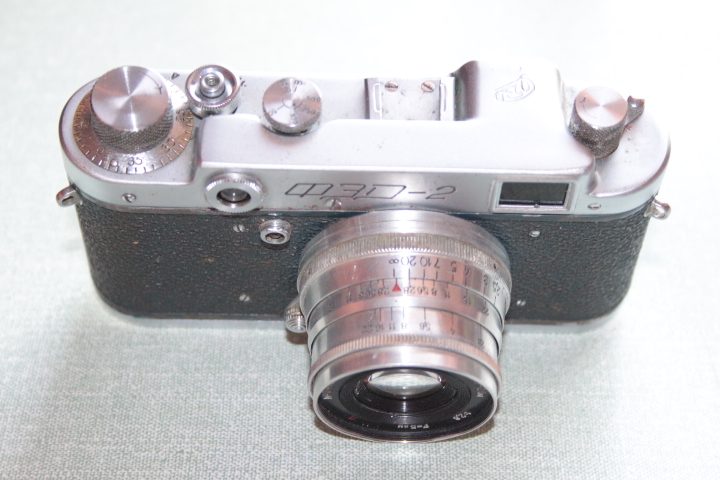
Fed 2 (B4) (ФЭД)


I wanted a Fed camera since I first saw one many years ago. The external design is very much "form follows function" (and I suspect the internals is as well). When I finally bought a Fed, it was a Model 5B which was box-like and anodyne - it also leaked light and I got rid of it after my test film.  This Fed 2 is much better. 

Fed-2 (C) John Margetts

A brief history: the Fed was originally conceived as a training project for boys in a Ukrainian children's home. The idea was to teach the boys basic engineering by making quality cameras - the model selected being the German Leica II. They are often decried as being poor copies of the Leica but I don't think they are either poor or copies. The Fed 1 was essentially a copy of the Leica II redesigned to allow it to be made on less sophisticated machine tools by trainee engineers. The Fed 2 (the camera this blog article is about) is a complete redesign so it is more accurate and meaningful to say that it is inspired by the Leica II rather than a copy of it.

After the Germans destroyed the Fed factory in Kharkov, Ukraine during World War II, production was transferred to the KMZ factory near to Moscow - this resulted in the Zorki-Fed and, ultimately, the Zorki line of cameras. I bought one of these  - a Zorki 4 - and I am very pleased with it. The joint lineage of these two cameras is clear but they are very different.

So - both the Zorki and fed line of cameras are based on the German Leica II. The Fed 2 was made between 1955 and 1970. The Ukrainian seller tells me mine is a Model 2, Type B4 so it was made between 1956 and 1958. The quality of the Soviet engineering is shown by the fact that the camera is working well after 60-odd years.

This camera is a 35mm rangefinder camera. the top plate measures 140 mm by 32 mm. There is a raised "L" shaped hump in the middle of the plate. This houses the rangefinder mechanism. In the front of this are two windows - the viewfinder window and the rangefinder window. They are 67 mm apart which means that the rangefinder will be very accurate - this aspect of the Fed 2 was taken from the Zeiss Ikon Contax camera. The windows on the Leica II are much closer together.

Fed-2 top plate
On the left end of the top plate is the rewind knob. this pulls out to make rewinding the film easier. At the base of the rewind knob is a lever to adjust the dioptre level of the viewfinder. This excellent device means I can use the camera without wearing my glasses.

On the left end of the top plate is the film advance knob. This turns clockwise which I find to be non-intuitive but it works well enough. Beneath the film advance knob is the frame counter. This counts up from zero to a maximum of 36. Beside the film advance is the shutter release. This is towards the back of the top plate which I find to be a less than natural position but, again, it works well enough. The shutter release is threaded for a standard cable release. Around the shutter release is a milled collar. This is the rewind clutch - you press it down and turn it clockwise where it will lock in position while you rewind the film. Once the film is rewound, you must turn the collar anti-clockwise before loading a new film.

-------------------------------------------------------------------------------------------------------------------------
Blog (C) John Margetts, 2015
-------------------------------------------------------------------------------------------------------------------------

Next along is the speed selector dial. This is set by lifting the dial and rotating to the required speed. There is a central post with an engraved dot to mark the selected speed. This is a big improvement over the usual Soviet system as the shutter on this camera can be set either before or after the film is advanced. The usual advice for Soviet cameras is to only change the shutter speed after winding on the film. Actually, as far as I am concerned, I always advance the film immediately after taking a picture - I do this so that the camera is always ready - so I am always going to set the shutter speed after advancing the film.

Also on the top -plate, in line with the lens, is an accessory shoe. There are no flash contacts here - 1956/8 is much too early - so a 'cold' shoe in flash terms.

The rear of the top plate has the camera serial number. This does not match then usual Soviet system of starting the serial number with the year of manufacture so dating the camera by this number is not straight forward. The front of the top plate is engraved with the model name in Cyrillic - ФЭД-2 or FED-2 in Latin script - and ФЭД is repeated on the top near the rewind knob.

Fed-2
The front of the camera is simple. There is the M39 (also called LTM) lens mount offset to the left of centre. At the top of the mount, the rangefinder cam slightly protrudes. In fact, this is in then way of screwing in the lens and it is essential to set the focus on the lens to its nearest point (1 metre in this case) to make fitting the lens practicable.

To the right of the lens mount is the flash PC socket. In later versions of the Fed -2 this PC socket gets moved onto the top plate - this is one of the ways of determining the type of Fed-2 you have. This camera has no shutter delay lever - again, added to later versions of the Fed-2. What I do appreciate is the presence of a strap lug at either end of the camera.

The base of the camera has a fixing cam at either end. turning both half a turn allows the back/base to be removed to allow fitting and removing of the film. The base also has a tripod bush (the old standard of 3/8 inches Whitworth so none of my tripods will fit unless I 'borrow' a 1/4 inch slug from one of my Zeiss Ikon cameras to fit into the 3/8 inch thread).
Fed -2

The lens that came with this camera is an Industar-26M which is a 50 mm, f/2.8 Tessar type lens. I suspect this is the original lens for the camera - it is certainly of the correct type and date. The lens focusses from 1 m to infinity and has apertures available from f/2.8 to f/22. There is also a depth of field scale which is invaluable if, like me, you use hyperfocal focusing (at f/22, everything from 1.5 m too infinity will be in focus if you set the focus at 3 m). The lens is coated - as is to be expected in the late 1950s - signified by a red п - on the lens bezel.

In use, this is a capable and pleasant camera. The shutter is as quiet and vibration free as a cloth focal plane shutter is going to be and much more gentle than either my Zenit E or Zorki 4. The viewfinder eye-piece is rather small and is surrounded by a milled steel ring which is bad news for modern plastic spectacles. On the plus side, there is a dioptre adjustment for the viewfinder so I can use this camera without wearing my glasses. Also, the viewfinder is not as bright as it could be. It is tinted green/blue to give maximum contrast with the yellow rangefinder spot which is really clear and makes the rangefinder easy to use.

On the negative side, I have had a serious problem with loading the film. On the face of it, loading is really easy - you insert the end of the film beneath a brass strap on the (brass) take-up spool and then wind-on. Unfortunately, my first film slipped out of place after I had replaced the back. When I thought I was advancing the film, the film was winding around the sprocket shaft rather than around the take-up spool Once there was five or six frames around this shaft the camera completely jammed. This was quite easy to sort out but involved opening the back of the camera with the film in place and cost me half a roll of film.

Despite the seller assuring me that the rangefinder had been correctly adjusted prior to sale, it is clearly not. When the lens is focussed at infinity, the rangefinder split image will not coincide.  As adjusting this is fairly simple, I might have a go myself, but I am not really bothered as I usually use hyperfocal focusing rather than precise focusing. On the other hand, it would be nice to have the camera as it should be.

Examples from the test film to follow.

3 April 2015

Test film was a disaster!  One picture from a 24 exposure cassette.  I am hoping that this is me leaving the lens cap on (I certainly did that few some shots) and I am trying a second film with the lens cap left at home.

Fed 2 test film


Apart from the appalling light differences from left to right (entirely down to me) this shot is quite good. Focus is good, contrast is good, exposure is good.  With an older focal plane shutter there is a likelihood of the two shutter curtains not moving smoothly together leaving differently exposed strips.  Hopefully with the second film I will be able to report more thoroughly on this camera.

Second film

This is no better. I am certain the lens cap was not left on as it was left at home.  Three images from 24 frames - not very good and shows that the shutter is not opening most of the time. This is strange, as with no film loaded, and the back removed, the shutter definitely opens every time. My best guess is that the back is either fouling something or is distorting the body.  In addition to the shutter not opening, there are very clear pin-holes in the shutter curtain. This shows up in the black frames below are three bright spots. These are also visible on the three images I got. The camera is useless.


Fed 2 - with three very clear pin-holes


Fed 2 - pin-holes not so clear but still there

Fed 2 - clear pin-holes
Fed 2 - pin-holes with the film not wound on for some time
Fed 2 - pin holes with the film wound on fairly quickly - so smaller spots.

Sunday, 1 March 2015

Kodak Retinette (type 017)

Visually, this is very like an early Retina - see my description of my Retina I type 119 - I gather the Retinette line was introduced for the folding 35 mm cameras with no rangefinder.

Before I go on to describe this camera I want to repeat the standard advice regarding using the V or self-timer setting on old cameras. The advice is not to touch this setting as the mechanism is likely to break rendering the camera useless. The man who sold me this camera was honest enough to tell me the shutter was jammed. I bought the camera on the basis that I have never had a serious problem with a Prontor shutter and did not doubt that this one would prove to be alright.

The problem was indeed that someone had tried the self-timer and the shutter had jammed. It took me nearly ten minutes of jiggling the various levers on the shutter to free the mechanism. The shutter is still not as free as it should be but an hour or so of repeatedly dry-firing the shutter will usually free the mechanism admirably.

Retinette type 017
This camera is a folder. The model name is a Retinette and it was made by Kodak's German factory. There were later models I, Ia, II etc. As well as model numbers, Kodak also produced types. This is a type 017 and was made between 1952 and 1954. The lens serial number tells me it was made in 1952. According to Dave Jentz of the Historical Society for Retina Cameras the lens was engraved with a serial number on 3 November 1952. It would have been three to six months before the new lens was fitted to a camera body by Kodak. The body also has a serial number - 928380 - but I have been unable to find any information relating to serial numbers to dates.

There is a button on the sole plate to release the front door. This does not spring open as some folders do, but the instruction book specifically says you need to pull the door open so this must be how it is intended to work. The action here is smooth enough so I am not going to lubricate the many joints in the struts - usually this is necessary on old folders but not here.

In common with the Retina series, there is a metal plate between the bellows and the shutter housing. This is purely decorative - it is missing on the Voigtlander equivalent (Vito and Vito II) - but is very effective visually. To close the camera, there is a small stud both top and bottom of this decorative plate that must be depressed to unlock the folding mechanism.

The shutter is a Prontor SV shutter - the letters SV tells us the shutter is synchronised for flash ("S") and has a self timer ("V" = Vorlaufwerk). In common with other early fifties shutters, there is a cocking lever and a release lever. The release lever is connected via a spring steel strap to a release button on the camera's top plate - and via this to a double exposure prevention mechanism. The fast shutter speeds work well - the test film will show me how well - but the slower speeds (1/10, 1/5, 1/2 & 1 seconds) are very slow - the one second setting is about 1 1/2 seconds. that is about 1/2 a stop out which is within the exposure latitude of film. This means the shutter should be usable at all marked speeds - I am not someone who gets hung up about precision, I am more concerned about usability.

The shutter has three Happy Snapper settings. There is a red dot on the aperture scale at just smaller than f/5.6 (I would guess f/6) and f/11 is also in red. These are used in conjunction with two small circles on the focus scale. In the manual, Kodak has these for use with different films.

For Kodachrome film (colour slide film, no longer in production) you should set the shutter speed to 1/50 (marked in red), the aperture to the red dot and the focus to the small circle on the focus scale near to the ten foot mark. This gives you a focus range of seven feet to fifteen feet - intended for portraits. For landscapes you should use the second small dot near the twenty five foot mark. This last is the hyperfocal distance for this lens at f/6 - everything from thirteen feet to infinity will be in focus.  These settings assume bright sunshine.

For Kodak Plus X (monochrome film, no longer in production) you should set the shutter speed to 1/50 (marked in red), aperture to f/11 (marked in red) and the focus to one of the small circles. The first small circle (near to ten feet) gives a focus range of six to twenty five feet and the second small circle (near to twenty five feet) gives a focus range of ten feet to infinity. This last is not quite the hyperfocal distance - to get this you need to set the focus to fifteen feet giving a range from seven feet to infinity.

The shutter comes with two flash synchronising settings - M and X.  For F class flash bulbs and electronic flash, you use the X position and can use shutter speeds up to 1/100 seconds.  For M class flash bulbs the process is more complicated.  For these bulbs there needs to be a slight delay between firing the flash and opening the shutter.  This is to give the flash bulb a chance to burn to its maximum brightness before the shutter opens. For these M class bulbs, you set the synchronising lever to M and then set the delay timer (there is a second yellow M by the delay timer lever to remind you to do this).  The delay system does not come into effect other than to give a fraction of a second delay as just mentioned.  In order to actually use the delay timer for taking a picture, it is necessary to set the flash synch to X first.

The top of the camera is as we might expect of a 35 mm camera.  On the right is the film advance knob (we are still a few years away from having a film advance lever) and on the other end is a film rewind knob. This is activated by a small lever beneath the film advance knob marked R and A. The centre of the top plate has the small viewfinder. It was usual at this time (late 50s) to have very small viewfinders and this one is impossible to use while wearing glasses. On the left of the viewfinder is the accessory shoe - at this time it was as likely to house a rangefinder as a flash so I am still not calling it a flash shoe. On the right of the viewfinder is the frame counter - this one counts down so shows the frames left to use. it is easily set to the film length by rotating it using the two small studs on the disc. Between the frame counter and the film advance is the body shutter release. You can only depress this once the film has been advanced. As the interlock is freed by the film physically moving over the sprocket wheel, there has to be a film in the camera before the shutter will fire (you can 'cheat' and fire the shutter at the shutter housing, if you want to).

The base of the camera is plain apart from the tripod boss - the standard 1/4 Whitworth thread.

My test film is still waiting to be developed - later this week, I hope - and I will post the test pictures when they are ready.

Tuesday, 27 January 2015

Balda Super Baldina


This is my second Balda Baldina. The first is a folding Baldina from the 1930s. The Super in the name indicates that it has a coupled rangefinder. This new Baldina is from the 1950s and is not a folder but nods in that direction with a collapsible lens. This is fairly effective - it reduces the thickness of the camera by two cm which means it easily fits in a jacket pocket. The camera leatherette is stamped "Made in Germany" and the focus scale is in feet, indicating that this is an official import into the UK.

Balda Super Baldina (C) John Margetts
The top plate is as you might expect from a mid-1950s German camera. In the middle is a large hump containing the viewfinder and rangefinder. This has both the viewfinder and rangefinder eyepieces in one - my Franka Solida of the same period has separate viewfinder and rangefinder eyepieces which makes using the camera awkward. On the top of the viewfinder/rangefinder hump is an accessory shoe - no electrical contacts at this date, so a cold shoe.

Balda Super Baldina top plate.
On the left of this hump is the rewind knob. This is surrounded by a film type reminder. There are four options for this - film speed in DIN, film speed in ASA, colour positive or colour negative.  To the right of the hump is the film advance. This is a lever with a large, coarsely milled thumb post.This moves through 180 degrees to advance one frame which is easily done in one throw of the thumb. At the base of this is the frame counter. This counts up from one to thirty six. In front of the film advance is the shutter release. This is a fair-sized button, threaded for a standard cable release. I have a slight niggle here as the shutter release button is slightly below the level of the film advance level which makes finding the release button by feel less obvious than it could be.

On either end of the top plate is a lug for attaching a strap - this is far more important than camera manufacturers seem to understand.

With lens collapsed.
With lens extended.
The front of the camera is dominated by the collapsible shutter/lens housing. This is quite well organised with the parts easy to get at. The shutter/lens housing is mounted on a square stainless steel bezel. On the top right of this bezel is a button to release the collapsible housing. When pressed, the shutter/lens housing pops out with a satisfying clunk.

Around the base of the housing is the focusing ring. This has a large knob on it below the lens which makes focusing at eye-level with the rangefinder very easy. Between the focusing ring and the lens release button is a depth of field scale - something regrettably missing from more modern cameras.

The next control on this housing is the aperture selector. This varies between f/3.5 and f/16. There are no click-stops so intermediate positions can be selected. Outside of this is the shutter speed selector - this is a conventional ring. The shutter is a Prontor SVS (a Compur Rapid was also available) so shutter speeds are from one second to 1/300 seconds.  The 'S' in the shutter name tells us it is synchronised for flash - two 'S's tells us it can be synchronised for M (bulbs) or X (electronic) flash guns. The V stands for Vorlaufwerk which indicates a self-timer is available.  There is a PC (Prontor Compur) socket set into this housing for attaching a flash gun.

Balda Super Baldina rear/internal view.
The shutter controls have Happy Snapper settings - f/8 is in red and there is a red dot at nine feet and a green dot at around thirty feet. The red dot is intended for portraits and will give you a focus range of six feet to twelve feet - suitable for a head-and-shoulders shot or a small group. The green dot is for landscaped and is the hyperfocal distance at an aperture of f/8 - it gives a focal range of 12/13 feet to infinity.

The focusing knob moves the whole shutter/lens assembly. this means that the whole lens moves to focus rather than just the front element. This means that the lens always performs at its optimum - whatever that optimum might be. The lens is a Baldinar which is made for Balda rather than by them. There were a host of lens-makers in Germany making lenses for camera manufacturers and this could have come from any of them or, indeed, several of them. The lens is a triplet (three pieces of glass) which is unlikely to perform well with a wide aperture. my experience of German triplets is that they perform very well once stopped down to f/8 or smaller. At the date this camera was made, the lens will be coated - and there is the tell-tale blue sheen to the lens to confirm this.

The inside of the lens front is threaded for filters. I make it to be 35mm diameter but that could be plus or minus a millimetre or so.

On the rear of the top plate, to the left of the viewfinder eyepiece, is a large screw. I suspect this is to adjust the rangefinder but as the rangefinder is working fine I am not going to fiddle with it to find out for sure. The rangefinder works as they usually do. There is a central spot that needs to be aligned to the main image by moving the focusing knob on the front of the camera. This spot is clear, even in poor light, which makes the rangefinder useful in practice - not something I find you can safely assume. One quirk here is that the rangefinder spot is pale blue in colour rather than the more usual yellow but that does not affect its usefulness.