Showing posts with label 120 film. Show all posts

Tuesday, 29 December 2015

Bronica ETRS


I am a bit of a tight-wad. I very rarely pay as much as £20 for a camera. While this makes for a fairly cheap hobby, it does preclude me from buying many models. For many years, I have been looking wistfully at medium format SLRs - such as Hasselblads, Mamiyas and Bronicas. Unfortunately, you just cannot buy these for under £20. 

I have recently retired and this excellent arrangement has bought with it a modest lump sum which has been burning a hole in my bank account. So, one Bronica ETRS has been purchased - at 10x my self-imposed limit (actual cost was £189). This has proved to be a confusing camera to buy. These medium format SLRs are very modular and, looking at Ebay, it is usual to sell each module separately. My problem was that, never having handled one of these before, I was not clear as to exactly which modules were essential and which were optional. I got around this by going to a shop (ffordes in Inverness) and buying a complete system from them with a reassurance that I was buying a complete camera. probably cost me a bit more this way but I also got a six month guarantee as well as peace of mind.

My camera is a basic set-up. It consists of four modules: a body, a lens, a film back and a viewfinder. The only module that is essential is the body - there are no choices here as far as I can ascertain. The lens I have is a 75 mm lens which is 'normal' for the 6 x 4.5 negative format of these cameras. There are other focal length lenses available ranging from 40 mm (equivalent to 25 mm on a 35 mm camera) to  250 mm (equivalent to 150 mm on a 35 mm camera). There are four options for the film back - 120, 220, Polaroid and 70 mm. Only the 120 back is usable as neither the 220, Polaroid or 70 mm film is made anymore.

There are several options for the viewfinder of which the most common are the waist-level finder and the prism finder. I have the prism finder which is essentially what all 35 mm SLRs have. I may avail myself of a waist-level finder in due course. 

There are many other options options available, none of which is essential. The only module I need that was not supplied is a neck strap. A lot of people do not use straps - even on very expensive cameras - but dropping things is far too easy not to use a strap. I have fitted a cheap and cheerful Chinese strap.

Description.

I am going to describe each of the four modules in turn and then describe the complete camera.

First, the body. With the other modules detached, the body does not look like very much. It does, however, contain all the electronic controls.

It is a cube - it measures 90 x 70 x 85 mm (OK, not exactly a cube, but near enough) and weighs xxxg. 

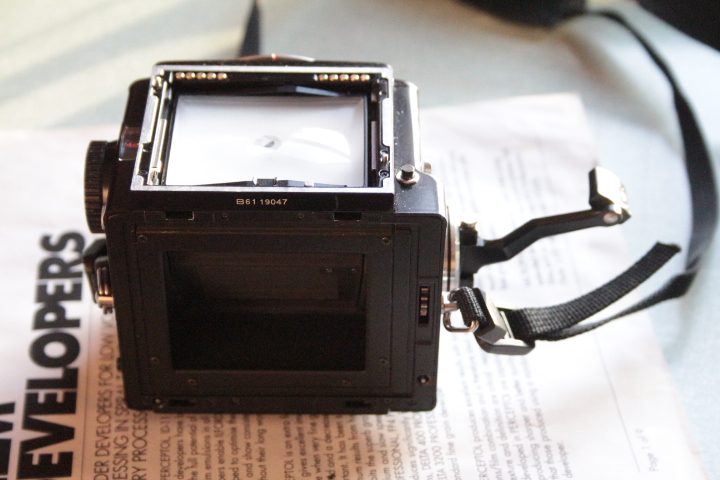
The top face is dominated by the focussing screen. This is plastic and measures 55 mm by 42 mm - the 6 x 4.5 in the camera name is the nominal negative size but the actual size is a bit smaller. This gives an aspect ratio of 1:1.3 - 35 mm cameras are 1:1.5 as are most digital cameras and full frame 120 cameras. This means that I shall have some adjusting to do when composing pictures and printing them. I usually print on A standard paper which has an aspect ratio of 1:1.4 - I shall have to either crop the picture or trim the paper.

The focussing screen is removable - several options are available - but this one has a plain field with a split-image centre surrounded by a circle of micro-prisms.

In front of the focussing screen is a row of ten electrical contacts. These are there to allow for the use of a metering viewfinder - by default, no metering is provided meaning I need to use a hand-held light meter which is my default method of working regardless.

Also on the top are the displays for shutter speed and frame counter both in windows on the sides and also a release button for the viewfinder.

The left-hand face of the body has the shutter speed selector. This is a knob and ranges from eight seconds to 1/500 seconds. Whole seconds are displayed in red, fractions in white.. This might seem a b it meagre by modern standards but is more than adequate with careful selection of film speed.

On the top corner of the left-hand face is a battery check button Pressing this lights a red LED in the corner of the focussing screen. half-way down the right-hand edge is a strap lug. below this is a button to release the film back. last item on this side of the body is a cable release socket threaded for a standard release cable. 

The right-hand face of the body is dominated by the film advance. This is a large crank handle that you turn one complete revolution to advance the film one frame, lower the mirror and cock the leaf shutter in the lens. Above this is a small lever. This turns through 90 degrees to allow for multiple exposures on one frame of film. Behind the film advance crank is the second strap lug.

The bottom face of the body has the battery compartment which takes a single 6v battery. In front of this is the 1/4 inch UNC tripod boss.

The rear face of the body cube has fitting s for the film back and an exposed cog for the film advance. In the centre is a large hole which is blanked off by a hinged plate - more of this later.
The front face of the body cube is mostly the lens mount. This is huge by 35 mm and digital standards. It has four lugs and is specific to the ETR range of cameras. Inside the mount are six electrical contacts which are a part of the automatic exposure system. Also inside the mount is the reflex lens.

Below the mount are two chrome buttons. On the right (when holding the camera) is the shutter release button. This ass a knurled collar around it which can be turned to lock the shutter release. Turned fully anti-clockwise, it frees both the release button and the cable release. Turned 45 degrees clockwise, it locks the release button but still allows the cable release to fire the shutter. Turned 90 degrees clockwise, both the release button and the cable release are locked.

In the top corner is a PC socket for flash. No accessory shoe is provided as standard so any flash gun must be fitted to the tripod boss - or you can buy the accessory grip which has a hot shoe on it.

On the left is the lens release button. This needs to be turned and then depressed. While depressed, the lens can be turned clockwise for removal.

in order to have a functioning camera, three things need to be fitted to the camera body: viewfinder, film back and lens. Other options are available but these three are essential.

I am going to start with the viewfinder as this is the simplest. There are choices here - none is provided as standard - and I have the prism finder. This is the same as the viewfinder on a 35 mm SLR film camera or on a DSLR digital camera. It means I can see the image the right way up and the right way around.

A second option is a waist-level finder. this allows the camera to be used without lifting it to your eyes - usually on a tripod. With this finder the image is the right way up but back to front. This needs getting used to but I have no trouble adjusting to other cameras with waist-level finders.

The third option is that of a metering finder. this is essentially a prism finder with a built-in light meter to give TTL (Through The Lens) light readings. I am happy with my hand-held meter.

The film back has four versions. I have the 120 back - it takes 120 size film, believe it or not.  Also available are 220 backs, Polaroid backs and 70 mm backs but film is not available for any of these.

The film back holds the film (obviously) and can be removed from the camera with film in it. To do this, you have to insert a thin steel dark slide into a slot in the side of the film back. The film back can be opened tom allow for the inserting or removal of film. Inside the film back is a cradle for holding the film in place and advancing it. This needs to be removed to load film, but exposed film can be removed with the cradle in situ.

The cradle has two holders for the film spools, a cog to engage with the camera body for advancing the film and an external knob for manually advancing the film while loading. A nice touch is the presence on the rear door of the film back of a holder for the end of the film carton as an aide memoir.

The lens is quite a heavy lens. mine is a 75 mm lens. As well as containing the actual glass - five elements in four  groups - there is the diaphragm (f/2.8 to f/22) and the leaf shutter. If you have several lenses, each will have its own shutter. These are leaf shutters made by Seiko rather than the focal plane shutters most 'serious' cameras have.


In use.

In use, this camera is an anachronism. The shutter system is that used by Zeiss Ikon in their Contaflex cameras in the 1950s. There are actually two shutters in use. Between exposures, the leaf shutter is open, allowing the user to view the image through the lens. To prevent the film being fogged, there is a secondary shutter in the camera body behind the mirror - the hinged plate mentioned earlier. This secondary shutter is crude - it cannot be used for timed exposures. 

When you fire the shutter there is a complex sequence of events.:
1) the leaf shutter closes
2) the mirror lifts out of the way
3) the secondary shutter lifts out of the way
4) the leaf shutter opens for a timed exposure
5) the leaf shutter closes again.

When you advance the film, most of the opposite happens:
6) the secondary shutter closes
7) the mirror comes back down
8) the leaf shutter opens for viewing.

All this makes for quite a resounding clunk - compared to my 120 Ikoflex which only has the leaf shutter to move and is nearly silent and vibration free.

Test film.

This is encouraging. The shutter works fine, there are no light leaks, aperture and shutter speed are at least in the right ball park, film advance is correctly spaced. What is not evident on these small scans is the image quality - it is superb.


Sunday, 12 April 2015

Voigtländer Bessa 66


This is a medium format folder from the German firm of Voigtländer. It dates from between 1938 and 1940. This model was also made after WWII from 1946 to 1950, but my camera is a very early model - more later. There was also a cheaper version available with a folding viewfinder and no automatic framing.  It is extremely similar to the later Perkeo that replaced it in 1950.

Voigtländer Bessa 66 (C) John Margetts


This camera has a lot of 'modern' features that make it stand out from earlier folding cameras. These include a body shutter release and automatic frame advance - no need to look in the red window when advancing the film, the camera spaces the film automatically (more or less, it does not work too well on my camera. I used the red window).

First, a basic description.  The camera measures 125 mm wide by 40 mm thick and 80 mm high when folded and 95 mm thick when open. This is very much a pocket camera even if the pocket needs to be robust enough to take the weight - 524 g without a film. As standard, the top plate is uncluttered. It is made from chrome plated brass  and has a reverse-Galilean viewfinder right at the right-hand end. On the opposite end is the film advance knob. Close to the advance knob is a frame counter - one of the 'modern' features I mentioned. That should be all that is on the top plate but a previous owner has glued an accessory shoe on using a large amount of epoxy glue.  Close to the rewind knob, on both the front and back faces of the top plate are two sliders. Without an instruction manual, it is not clear what these do. The one on the front clearly advances the frame counter and seems to free the advance system to allow the film to be advanced. When the film moves through the camera, a feeler shaft rotates and this serves to measure the amount of film that has moved and the film advance locks when one frame (62 mm) has moved. There is no clear use for the rear slider but I think it might have to do with setting the start of the film once the red window has been used to line up the first frame. I would welcome advice here from anyone who has a better knowledge of this camera. This system only works sporadically with my camera and when using the test film I relied on the red window for all frames.

As this is a folding camera, the lens is hidden behind a door that must be opened before using the camera. This is achieved with a button the the base. Pressing this causes the door to spring most of the way open - it might well have opened completely when new. When open, it locks the lens/shutter firmly in place. To close the lens door again, there is a chrome bar beneath the lens which must be firmly pressed to unlock the struts holding the door in place. 

As supplied new, this camera came with a hinged yellow filter ('Moment' filter) but this has long since broken off as is usual for cameras of this age. Also as a consequence of age, the bezel around the lens has come loose and fallen off (it was glued in place). This means I have no lens name or focal length information but I can gather this from information from the interweb. The lens has a serial number (located inside the camera on the rear of the lens). The pre-war versions of this camera were supplied with either a  three element Voigtar or four element Skopar lens. Of these, only the Skopar had a serial number so mine must be a Skopar lens. It is a 75 cm focal length lens (as was the Voigtar option) with a maximum aperture of f/3.5. The shortest marked focussing distance is 1 m, but the lens will move significantly further than this so the closest focus is going to be nearer to 0.7 m at a guess. The lens is not colour corrected (that would be a Color-Skopar) and is not coated but performed well regardless.

The shutter is a Compur shutter with a serial number of 3 751 602 - my records tell me that this dates from between 1935 and 1939. The lens serial number is 2 245 637 and this dates from between 1937 and 1942. (The range of dates is so vague because both Compur and Voigtlander lost most of their records in the destruction of WWII.) I have a piece of further dating information in that the slider on the front of the top plate was removed in 1939 so my camera must be from 1938 or early 1939.

The Compur shutter has a fastest speed of 1/300 seconds (later models had a Compur-Rapid shutter with a nominal 1/500 second speed) and apertures from f/3.5 to f/16. Both of these are very usable in 2015 with modern film. What is missing from this shutter is a delay timer and any flash connectors. For my test film, I used Kodak Portra 160 ISO film in sunny weather in April and shot most of the film at either 1/100 or 1/300 and f/11 or f/16. As is usual for this date, the shutter needs cocking before use. While the primary shutter release is on the shutter housing, the actual release is a lever that protrudes through the lens door. This is strictly left-handed in use, leaving your right hand to have a firm grasp of the camera.  Exacta did things the same way.

The base plate has three items. On the left is a lever with two functions. In the closed position, it prevents the back being opened and when swung out, it acts as a foot to allow the camera to be securely placed on a flat surface for longer exposures (together with a cable release, which the shutter is threaded for). There is no delay timer, so no selfies with this camera. In the centre of this lever is a tripod boss. This is a 3/8 inch Whitworth socket with a 1/4 inch Whitworth insert.  At the other end of the top plate is a depth of field calculator. You rotate the disc to set the distance you are focussing at to the pointer and then read off the depth of field against the aperture you are using.  The third item on the base plate is the release for the lens door.

In use, this is a simple, easy camera to use. The hardest part is the viewfinder which, as was normal in its day, is rather small and not usable while wearing glasses. With the left-hand shutter release, you can get a really good grip on the camera while actuating the shutter release with your left index finger. It is easy to cock the shutter with your right hand while still gripping the camera. 

The hardest part is reading the numbers on the shutter speed, aperture and focus scales. They are rather small for my ageing eyes.

As is common of Voigtländer cameras, there are Happy Snapper settings on the lens. These are marked by a small triangle and a small circle. If you set the focus to the triangle and the aperture to f/8 then all between 2.5 m and 5 m will be in focus (ideal for portraits) and if you set the focus to the small circle, and the aperture to f/8 then all between 5 m and infinity will be in focus (ideal for landscapes).

Even though the lens is neither colour corrected nor coated, it has performed well. There is no visible colour fringing (the panchromatic films in use in the 1930s would have needed well corrected lenses) nor is there any significant flare visible in my test pictures. Where I have shot Contra Jour, there is some slight evidence of flare but it is very minor. I have much worse lenses in my collection.

The film I used for my test was Kodak Portra 160, developed and scanned by Snappy Snaps in Lincoln.  Loading the film is easy - both spool holders are hinged. The camera takes either 120 or 620 film (only 120 is currently available). The dark bar along the right-hand edge of some frames is a scanning artefact, not the camera.


Shot into the light - some flare on the right-hand edge


Thursday, 11 December 2014

Enfield folding camera

This camera is a British Ensign camera - it was generously given to me by Harry Davies.  It is a folding camera of a very standard design. Visually, it is very similar to both a Zeiss Ikon Nettar 515/2  and an Agfa Billy Record. Dating it is problematic, not least because I am not sure of the model. The camera has a Gauthier Singlo shutter which was introduced in 1937 so the camera was made in either 1937, 38 or 39 - WWII got in the way of German imports so that rules out the 1940s.

Ensign, folded
It measures 160 mm by 75 mm by 32 mm. Actually, as this is an English camera, I ought to put the measurements into the old Imperial units: 6 1/4 inches by 3 inches by 1 1/2 inches. That is the metal body - the viewfinder, winder knob and catch protrude from that.


As far as I can see, the body is made from pressed steel [painted black. The flat surfaces are covered in black leatherette. the name "Ensign" in handscript is embossed on the front near the catch for the back and "Ensign. made in England" is embossed on the back. There is no model name embossed anywhere. There is the name "Singlo" on the shutter fascia and there are references on the Interweb to an "Ensign Singlo". The shutter, made by Gauthier, is a Singlo shutter and the "Singlo" refers to the shutter (the same stamping in the metal appears on other camera makes) rather than to the camera model. of course, that does not preclude Ensign from using the same name for the camera.

The top of the camera is plain black with just a folding viewfinder. This is a very basic double frame with no glass. the bottom of the camera has a chrome-plated film advance knob and a small button to release the catch on the lens door.

Ensign, open, side view
The back of the camera is also plain with a single red window for the film frame numbers. The front of the camera has the lens door. This has the usual folding leg so that the open camera can be stood on a flat surface. There is also a small (3/8 inch) screw. Undoing this leaves a 1/4 Whitworth threaded hole for a standard tripod screw.

When the door release is pressed the door opens about half-way on its springs. This camera has been stored somewhere damp and the door/lens struts have some areas of corrosion. When new, I suspect this door would have opened entirely on its own. When open, the lens/shutter housing is held very securely.

The shutter, as already mentioned a couple of times, is a Gauthier Singlo - this offers two speeds: 1/25 and 1/75 plus B and T. This shutter is an everset type - there is no cocking lever - but there is a cable release socket.

Ensign, open, front view
The lens is an Ensar - Ensign's own make - which is 105 mm focal length. It focusses down to about four feet - the last marking on the scale is six feet but the lens moves significantly past this. The aperture ranges from f/7.7 to f/32. On the left side of the shutter housing is a Brilliant viewfinder. I always find these next to useless and always use the folding frame finders.

Inside is as you would expect. The film advance knob pulls out to allow the inserting and removing of the film spool. At the other end, to ease the inserting of the film the lower locating pin falls away - quite literally. I initially thought it was broken. This pin folds in automatically and is held in place securely when the back is closed.

In use.

This camera is quite easy to use.The only difficulty I had was with the positioning of the shutter release - in landscape mode, it is slightly beneath the camera and rather awkward to reach. In portrait mode it is fine. The folding viewfinder is large enough for me to use it while wearing my glasses - something that can not be said for much more expensive cameras of the period.

Test film

In its day, the pictures taken with this camera would have been printed as contact prints. that means they would be 9 cm by 6 cm which is about 1/3 of the size I have them here.  That means the defects would also have been 1/3 as big. In terms of sharpness and distortion, the lens is producing fine results. There is, however, a lot of vignetting - darkening in the corners of the picture - clearly visible in every shot.

The pictures were significantly underexposed. partly, this is down to my setting on my (old) light meter. The film I used was Kodak Portra 160 which, surprisingly, has an ISO rating of 160. Problem is my light meter does not have a setting for 160 so there will have been a bit of error in my guessed setting. I think the shutter might have contributed as well. Usually with old shutters, they run rather slow causing over exposure but this Singlo shutter is a simple two-bladed device and if the first blade is a bit slow, the second blade will catch-up giving a too-short exposures. Without paying for an expensive electronic test of the shutter, I cannot know for sure.

These pictures are a bit 'flat' which I entirely put down to the awfully dull weather we have had in Lincoln recently.

Silver Street, Lincoln

Witham, Lincoln

Broadgate, Lincoln, with cathedral

pedestrian bridge over Broadgate, Lincoln

Stamp End, Lincoln

Marshall's Yard, gainsborough

Tuesday, 18 November 2014

Agilux Agifold

AGI, who made this camera, are an aeronautical instrument maker - still in business - rather than a camera maker and it shows. During WWII, AGI made military instruments and that pedigree is followed in this camera. It is large and heavy and has no small controls so easy to use with cold hands, with gloves on, when frightened . . . 

lens: Agilux anastigmat
focal length:  9 cm
apertures: f/4.5 to f/32
focus range: 3 feet to infinity
lens fitting: fixed
shutter: Agifold
speeds: 1/25, 1/50, 1/100, 1/125, B, T
flash: two pin connector
film size: 120 or 620


Outwardly it is much like any other folding camera - Kodak, Zeiss Ikon, Voigtlander, Agfa all made similar. The main physical difference is the large double viewfinder. This consists of one large housing containing both an eye-level finder and a waist-level finder. The waist-level finder is pretty much a pre-war brilliant finder. This viewfinder housing also double as the catch for the lens board - it moves to one side to open the front. This housing is central on the top of the camera. Beside it is a shutter release button. This button links, via a series of links, to the shutter release on the shutter housing - again, standard fare for a mid-twentieth century folding camera. On the other side of the shutter housing is the film advance knob. this is nice and large and easy to use. Being a 120 format camera, there is no film rewind.


The shutter is made by AGI themselves but outwardly it looks much like a Compur or Prontor shutter. The adjustments are in the same place the main difference being the shutter cocking lever which is on the underside of the housing - rather inconveniently. The shutter release is also on the underside where it nicely links to the body release. The actual shutter itself is not in the same league as Compur or Prontor - it has only two leaves and is rather reminiscent of a box camera shutter. The speed selection is non-standard as well. 1/25, 1/50 and 1/100 are much as I would expect from 1948 but the next speed is 1/125 - the increase in speed is so small as to be pointless. It is usual for the shutter speeds to double in speed from one setting to the other which is one stop reduction in exposure but this is a 25% reduction and it is hard to see a use for it.

The lens is also made by AGI themselves (at least as far as I can gather from information on the Interweb) and is a 9 cm focal length (or 90 mm in modern parlance). The negative size is 6x6 cm so a normal lens would have a focal length of 85 mm. That makes this lens slightly longer than normal for the negative format, but not seriously so. The lens is coated (not a given in 1948) but I suspect only on the front surface. This has the distinct blue cast of a coated lens but the rear element is clearly not coated - no blue cast.

Being a 120 format camera, there is a window on the back to allow the user to see the frame numbers when winding the film on. Traditionally, these are red - red because early film was orthochromatic and not sensitive to red light - but on this camera you get a choice of red or green. There is a slider to uncover one or the other of these two coloured windows. What there is not is a cover for both windows which would have gone further in preventing fogging of the film.


I have been referring to this as a 120 camera but in fact it is a dual format camera - it will take either 120 or 620 film. The only difference between the two is the spool (the actual film being the same size with the same frame number spacing) and the spool holders here will take both sizes. The camera came to me with a 620 spool in place and I have now fitted a 120 spool to check the fit.

There is no accessory shoe so no way to fit either a rangefinder or a flash gun.  However, there are flash contacts - not the industry standard PC socket but two metal posts on the side of the shutter housing. These can be seen in the photograph of the lens above on the top right of the shutter housing.

When I took delivery of this camera, it was in quite a sad state. It had obviously been in a smokers house - it was covered in a sticky brown deposit - and also stored somewhere damp. Diligent use of WD40 and cotton buds has brought the camera up nicely - not quite in showroom condition but just about presentable. The shutter is not quite as I would like. An hour or so of dry-firing the shutter has it firing reliably and it sounds to be in the right general area speed-wise. One fault it has is that when set to 1/100 seconds and fired a few times the shutter resets itself to 1/50 seconds.

I am still in two minds as to whether I am going to try a film in this camera but if I do I will post the results here in due course.

Tuesday, 19 November 2013

Perkeo I


This is a nice, medium format camera from Voigtlander. It is a direct competitor to Zeiss Ikon's Nettar 518/16 - that is, at the lower end of the enthusiasts' 120 cameras - and is a replacement for the Bessa 66. This is a folding camera which fits nicely in a (large-ish) pocket. It measures 125 mm wide x 85 mm high x 40 mm deep (closed) or x 95 mm deep (open). It weighs 483 g. In 1952, Wallace Heaton were advertising this camera at £22/11/6 for the model I have here (that is in old money and equates to £22.57 in new money. That is equivalent to about £1,400 in 2013 values).
Voigtlander Perkeo I

lens: Vaskar
focal length:  75 mm
apertures: f/4.5 to f/16
focus range: 3.5 feet to infinity
lens fitting: fixed
shutter: pronto
speeds: 1/25, 1/50, 1/100, 1/200
flash: F synch only
film size: 120

The lens is a Voigtlander Vaskar - 75 mm focal length and maximum aperture of f/4.5. The Vaskar is Voigtlander's cheaper lens (a more expensive Perkeo I came with a Color-Skopar lens) and has a triplet construction (again, comparable to Zeiss Ikon's Nettar on the 518/16). I have yet to see the result of using this camera, but it has a reputation for having soft focus in the corners. This is not a fatal flaw for me as I have no need for sharp focus in the corners although I am aware that others find this unacceptable.

The shutter is a Gauthier Pronto - four speeds being available of which only 1/100 and 1/200 are of any interest. This shutter has a delayed timer (Vorlaufwerk) which, unusually for a camera of this age, works well. Flash synch is provided for fast flashbulbs - I intend to try this camera with electronic flash to see if this works as well.

The shutter release is standard for the early 1950s - primary release on the shutter housing and a secondary release button on the camera's top plate, linked to the primary release by a lever.  There is also a cable release socket which is between the two - on the hinged door.  The secondary release has a double exposure prevention mechanism fitted requiring the film to be would on before the shutter can be released a second time. On my camera, this does not work very well at the moment. When I had a similar problem on my Franka Solida II, it sorted itself out after a few shots.

--------------------------------------------------------------------------------------------------------------------------------
Blog copyright by John Margetts, 2014
---------------------------------------------------------------------------------------------------------------------------------

Being a folding camera, there needs to be a mechanism to bring the shutter/lens forward, ending with the lens exactly parallel to the film. On my camera this is defective - a small strut has snapped half way along its length. When I received the camera, this folding mechanism barely worked and then very badly - the lens ended up at quite an angle to the film plane.  This needed attention with naphtha to flush out dust and dirt, lubricating with clock oil and repeated folding/unfolding to free up the many joints in the struts.

Perkeo I - folded
It now unfolds easily and seems to put the lens parallel to the film plane, judging entirely by eye. The test film will tell me how parallel things actually are. The broken strut does not seem to matter here. What does not work too well is closing the camera. to close properly, the lens must remain parallel to the camera body otherwise it will not fit into the available space. I suspect that the broken strut is there is achieve this. Without this strut, my thumb has to do its duty. 

As an aside, I have tried a new technique with this camera. When lubricating small parts, it is quite hard to apply a small enough amount of oil to exactly the right place. Getting that small amount of oil into the linkage is a matter of working the linkage and hoping. This time I have diluted the clock oil two parts of oil to one part of naphtha to produce a very runny oil. Because the oil is diluted, once the naphtha has evaporated I am left with 2/3 of the amount of oil I applied. Also, because the oil is now very runny I am hoping that the oil will run between the surfaces of the linkages more easily before the naphtha evaporates to leave a very small amount of oil in place. So far, the only downside I have seen is that the naphtha is very good at wetting surfaces and has carried a small amount of oil over all the surfaces around the linkages. I am not convinced that this is a bad thing.


Perkeo I - showing top plate
Before loading the test film, there are two things I need to do. The first is to use compressed air to blow dust out of the inside. Moving film through a camera generates a small amount of static electricity and this will pull any dust onto the film. After that, I need to check the bellows for light leaks. To do this, I wait until dark (about five PM at the moment) and shine a torch onto the bellows at close quarters. Viewing inside the camera, any light leaks will clearly show.  I have found one very large one. That broken strut I mentioned earlier has scored the bellows material and created a line on pin-pricks. These will need sorting before I try the camera. Otherwise, the camera is good to go.