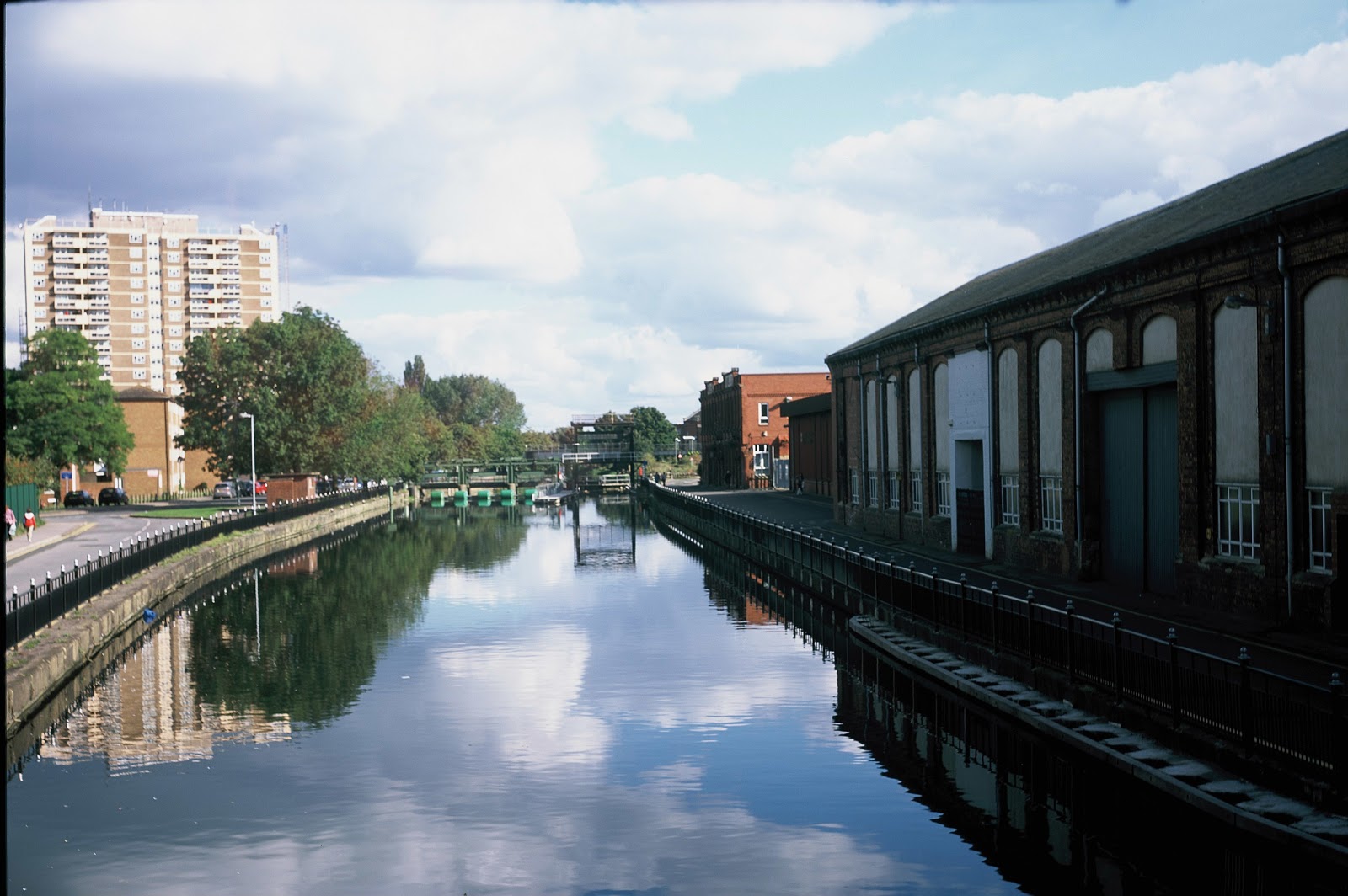
Zeiss Ikon produced quite a series of cameras called Nettar - both before and after WWII. These range from cameras producing 6cm by 9cm to 6cm by 4.5 cm negatives. Information on these is conflicting to say the least.
I have four Nettars - two are very early ones from 1934-ish (the year Nettars were first sold), from 1937 and the newest from the early 1950s. I shall describe them separately as they are totally different cameras. The four Nettars are 510 (Bob), 515/2 (the older ones), 515 (the newer one) and 517/16 (almost new one).
 |
| Left to right: Nettar 515, Nettar 515/2, Bob 510, Nettar 517/16 |
Bob 510
This camera is very very similar to the Nettar 515. Indeed, this camera (Bob 510) was sold in the UK as a Nettar 510 - the first of the Nettar line. The Nettar 515 is obviously an update of the Bob/Nettar 510. I am basing that on the dates for introduction I have found on the Internet: 1934 for the 510, 1937 for the 515 and the fact that the 510 is a much lower spec. than the 515. However, Tubbs has the dates of introduction as 1938 for the 510 and 1934 for the 515. This seems unlikely to me as the 510 has hinge on the baseboard that will not allow the fitting of a top-plate shutter release while the 515 hinge does. There would be no advantage in redesigning a perfectly good hinge in order to make a cheaper camera. Also, the lens standard on the 515 has provision to fit an optional brilliant finder while the 510 does not. Again, there would be no commercial point in redesigning the lens standard to prevent the attachment of the brilliant finder in the cheaper camera. The re-engineering would cost needless money and also prevent potential sales of optional auxiliaries. The serial number of the body tells me it was made in 1936
Apart from the lens/shutter options and the differences mentioned above, the 510 and 515 are identical.
The name "Bob" is an estimable one. It is an Ernemann name and dates from 1914. Ernemann was one of the four companies (Goertz, Contessa-Nettal, ICA and Ernemann) who combined under the aegis of the Carl Zeiss Foundation to form Zeiss Ikon in 1926. Zeiss Ikon continued to sell Bob III and Bob IV cameras but were using up stock from before the merger. These Ernemann Bobs bequeathed nothing but the name to the Bob 510.
As I said, the Bob 510 was marketed in the UK as the Nettar 510 but my specimen is clearly a Bob with the name "Bob" embossed in the leatherette and the distance scale is in metres. I am always a bit uneasy when I buy German versions of cameras from the 1930s - they were certainly not retailed here in the UK. I suspect many were taken as war booty by British soldiers or "bought" in exchange for unavailable items. However, that is now fairly distant past and is (always was) beyond my control.
This is a half-frame camera - full frame for 120 film is 6cm by 9cm. This camera produces 6cm by 4.5cm negatives - 16 to a roll of film. This is roughly four times as large as a 35mm negative and most of the defects of an old, cheap lens are off-set by the need to enlarge the pictures four times less.
The lens on this camera is a Nettar Anastigmat 1:6.3 with a focal length of 7.5 cm. This was below the standard for the time and marks the camera as a cheap version. F6.3 is very slow and faster lenses were available, in fact the 515 had a f4.5 lens just a couple of years later. Focussing is courtesy of the front cell only - usual on the lower end of the market, even with upmarket lenses such as Tessars. Focussing is from just short of 1.2 metres to infinity. This lens is fairly soft with a predisposition to flare as you can see from the photographs below.
The shutter is the fairly crude Derval by Gauthier - speeds are 1/25, 1/50 and 1/100 plus B and T. There is no delayed action lever. The fascia of the shutter, which was supplied by Zeiss Ikon rather than Gauthier, is a black and chrome Art Deco disc more reminiscent of Agfa of the time than nit is of Zeiss Ikon. The shutter is of the everset variety - there is no need to cock the shutter first as on a Klio or Prontor shutter. The shutter release lever has quite a lot of travel before it acts making firing the shutter a bit uncertain. This is much easier in landscape orientation but in portrait orientation one finger of the right hand has to move well under the lens while the rest of the hand has to hold the camera steady. As is usual, the lens/shutter combination has Happy Snapper settings signified by red dots. These are just larger than f11 and about seven metres. With the slow films of the 1930s, this would have required a slow shutter speed of 1/25 or 1/50 except in really bright light. The resulting pictures would not have stood any enlarging, but the customers for this camera would have been unlikely to have had anything other than contact prints from the 6cm by 4.5 cm negatives.
The viewfinder is a folding Galilean finder. The eye-piece is very small - 3mm by 5mm - and difficult to use while wearing spectacles. To add to this difficulty, the front part on my specimen is very worn and leans forward at an alarming angle. This means that precision of composition is not possible - but if I wanted precision I would not be using a seventy plus year old camera.
There is one tripod bush on the bottom at the end of the film holder. This protrudes from the casing and means that the tripod will not fit very securely. The main boss is 3/8 Whitworth but will take a 1/4 Whitworth insert - it probably had one to begin with.
 |
| Views along the banks of the Sincil towards Lincoln cathedral. |
515/2
This camera is a full frame 120 camera - that is it gives 8 off 6cm by 9cm negatives. This makes it an expensive camera to use but that is offset by the greater quality of the much larger negative. The body serial number tells me that it was made in 1932.
The lens is a Nettar anastigmat with a focal length of 11 cm (cm before 1945 and mm after 1945) which is "normal" for a 6cm x 9cm negative. This lens has an aperture range of f/4.5 to f/32 - quite a fast lens for its time.
The shutter is a Telma everset made by Gauthier - "everset" means the shutter does not need cocking - with a speed range of 1/25, 1/50 and 1/100 plus B and T. (B keeps the shutter open while the shutter release is pressed, T keeps then shutter open until the shutter release is pressed a second time). The shutter release is on the lens assembly and has two definite parts to its travel - tensioning the shutter and releasing the shutter. Although it requires a firmer touch than a Compur shutter which needs cocking, it is much faster in action. The shutter also has a delay action lever which delays the shutter by around ten seconds.
This was the fourth cheapest Nettar 520/2 - Zeiss Ikon advertised it at £5/10/0 in 1936. The bottom of the range (f6.3 Nettar lens and Derval shutter) sold for £3/15/0 and the top of the range (f4.5 Tessar and a normal Compur shutter) sold for £9/17/6 (all prices in 'Old Money'). The lens has a focussing range of slightly less than 4'6" to infinity. Both the focussing scale and the aperture scale have a Happy Snapper setting marked in red - about f13 and about 40 feet. Basically, this means that 40 feet is the lens's hyperfocal distance at f13 and nearly everything will be in focus at these setting.
There are two viewfinders - a brilliant finder that can be turned for Portrait or Landscape formats and a direct vision finder that is simply two open frames. I find brilliant finders hard to use but I suspect that this is (at least partly) due to inexperience. I much prefer the direct vision finder.
The camera is self-erecting - that is, you press the button on the body, the baseboard opens and the lens lines up correctly. You still need to pull the base board into position as it is not spring loaded like the 515 is. The same body button also opens the direct vision finder. There are two tripod bushes - one on the base board near the hinge and one on the bottom in the end of the film holder. This means that this tripod bush will not hold the camera very securely. Both are 3/8 Whitworth threads, both with 1/4 Whitworth inserts held in place with a grub screw.
The camera is designed to use Orthochromatic film which is not sensitive to red light. The red view hole in the back for noting negative numbers has no cover and if the camera is used with modern Panchromatic film, a degree of fogging could occur through this hole.
As you can see, there is a problem with the bellows on this old camera - there is a slight sag where the bellows join the camera body. I am not sure how easy this would be to fix. The many black dots are dirt that has been attracted to static on the film - a good but expensive way to clean the inside of the camera.
 |
| Cornhill, Lincoln, August 2011 |
 |
| Silver Street, Lincoln, August 2011 |
 |
| Stamp End, Lincoln - Fujifilm Provia |
|
515
My Nettar 515 was made in 1937, judging by the body serial number. It is of the 6cm x 4.5 cm flavour and is small enough to be considered a pocket camera even if it is rather heavy for a jacket pocket.
The Nettar 515 takes 120 film (all of the range do) and produces 16 pictures on a roll of 120 film. It is essentially a half-frame camera - as it uses each negative number on the film twice - once in each of the two red windows.
The camera sports a Novar Anastigmat lens - 7.5 cm focal length and maximum aperture of f/4.5, minimum aperture of f/22. Actually, the aperture lever goes beyond the f/22 mark by as much as the distance between f/16 and f/22 so perhaps is closing down to as little as f/32 at its limit. The shutter is a Klio made by Gauthier (which was actually owned by Zeiss Ikon). As this is a rim set shutter, it is not of the everset variety that early Klios were and needs cocking before a picture can be taken. Shutter speeds on a Klio are 1, 2, 5, 10, 25, 50, 100, 175 - all fractions of a second. This is adequate but causes problems in very bright conditions. It is probably better to restrict this camera to ASA (sorry, ISO) 125 film or slower.
The shutter has a Happy Snapper setting indicated by red dots. This is f/10 and focus at 24 feet. At this setting just about everything will be in focus. That is to say that 24 feet is the hyperfocal distance at f/10.
There is a delayed action lever which delays the shutter by about ten seconds which allows the photographer to get himself into the frame. On this camera this works but the usual advice for old cameras applies - don't use it. This is because the spring that controls the delayed action is fairly weak and might break with age. As is normal with pre-WWII shutters, the release lever is on the shutter assembly. By the mid 30s, it was de rigeur to have the shutter release on the camera body, which is exactly where it is with this camera. It is linked to the lever on the shutter assembly by two inter-connected levers - a bit cumbersome but it works well enough.
There
is one tripod bush on the bottom at the end of the film holder. This protrudes from the casing and means that the tripod will not fit very
securely. The main boss is 3/8 Whitworth but has a 1/4 Whitworth
insert held in place by a small grub screw.
There is also a tapered thread cable release socket but no flash connection - flash was unusual in the 1930s, particularly with amateurs.
The viewfinder is primitive - particularly by modern standards. It is a Galilean finder - two frames each with a lens which combine to give a viewfinder image slightly smaller than life size. Once a few pictures have been taken, it becomes second nature to use, although it can never be as accurate as a modern Galilean finder contained in one housing. There is provision for the attachment of a brilliant finder but my experience of these leaves me preferring the cruder Galilean finder.
A scanned copy of the original
Nettar manual for this camera is available as a download.
Also available is Zeiss Ikon's 1930s
exposure guide.
 |
| Lincoln Arboretum, 2011 |
 |
| Drury lane, Lincoln - looking north |
Nettar 517/16.
This is a post (WWII) war Nettar and has some improvements over the pre-war Nettars. There were two versions of post-war Nettars - 517/16 and 518/16 (the 16 in the designation means it takes twelve pictures on a roll of 120 (or BII) film. No, I'm afraid you will have to ask Zeiss Ikon why 16 and not 12). The only difference that I can see is that the 518 has a double exposure interlock and the 517 does not. This is a 517 and this comes in two versions. Mine has a square design top plate and later 517/16 cameras has a softer curved profile to the top plate.
Although these were not top-of-the-range cameras, they were not cheap either. I have a 1952 camera catalogue which prices the Nettar (not sure whether 517 or 518) at £16/13/3 (which is old money. It would be £16.66 in new money) for the basic model or £21/15/9 (£21.79 in new money). That is more than an average working man would earn in a week (£9 for a man, on average). In terms of an average man's wage in 2013, it equates to over £1,000 for a Nettar in modern money.
The controls are pretty basic (and much the same as the Nettars described above). On the top plate is a lens release button, a shutter release button and a winding knob. All other controls are on the shutter housing. Here is the diaphragm (f6.3 to f22), shutter speed (1/25, 1/75 and 1/200) and focusing (marked as being 4.5 feet to infinity but it focusses much closer - I suspect to one metre or three feet).
The lens is a Novar ( the same as on my 515) which is a triplet. These produce good results (better than many people expect) but needs to be stopped down for the best results. This lens is only f6.3 wide open so should always give good results.
The shutter is a Vario which is one of Gauthier's cheaper shutters. It only really has one useable speed - 1/200. It does have 1/25 and 1/75 but while these would have been fine for contact prints that were usual in the 1950s the resulting pictures would not bear enlarging due to the camera shake.
As was normal (at least on Zeiss Ikon's cheaper cameras) there are Happy Snapper settings marked with a red dot. These are focus at around 22 feet and slightly wider than f11 aperture. Using this Happy Snapper setting should give you a depth of field from 11 feet to infinity. When stopped down to f22, this lens should give you a depth of field from six feet to infinity.
The lens baseboard hinges down which I prefer as it leaves more room for your hands. it also provides a stable base for the camera which would be useful if the Vario shutter provided a Vorlaufwerk (or delay action) setting, which it does not. This camera also came with the more expensive Prontor S shutter which does have such a setting.
The release for the baseboard should allow the lens to spring into action just by the release being pressed. This is not so on my camera which is probably due to lack of use. I shall oil it directly and try the action a few times to see if it will free up. It is no big deal if it does not. The viewfinder on the 517/16 (and 518/16) has been modernised over the pre-war versions but not to provide an improvement. The viewfinder is now built-in to the top plate instead of being two folding frames; unfortunately, it is also much smaller. It is now too small for me to use with my glasses on which will make the camera harder to use. The image seen in the viewfinder is also much smaller, about a quarter of real life, and I need to get my really close to the viewfinder - this is why I cannot use it with my glasses on and when I try the metal surround scratches the plastic lenses on my glasses. On top of the viewfinder is an accessory shoe.
The film advance is on the left and on the top. This feels back-to-front to me but it is a perfectly acceptable system. There is one central red window on the back of the camera with a chrome slider to keep light out between shots. The spools are kept securely in place with spring loaded bosses. There is no provision for air flow around the film mask, so with this camera it might be a good idea to open the bellows before winding on the film. The reason for this is that the expanding bellows can act as a pump and suck the film into the space in the middle of the film mask giving a slightly curved piece of film in front of the lens. Conversely, wait a few seconds between opening the camera and taking the first picture.
Test pictures will be provided as soon as I have had the chance to try the camera out.
30-11-13: I now have my test roll developed - Fuji Provia reversal film. This camera has quite bad vignetting - it shows more on some pictures than others -I am assuming it has to do with the aperture used. The picture of Lincoln's Exchequergate has hardly any visible vignetting.
 |
| Lincoln's Exchequergate |
 |
| Lindesfarne Castle |
 |
| Bamburgh Castle |
Comparison between Ikonta 520, Bob 510 and Nettar 515:
These three cameras from Zeiss Ikon share the same aluminium
casting for their bodies. This makes them very similar cameras. They
all take 120 film and they all produce half-frame negatives of 6 x 4.5
cm. The details, however, are different. I shall give the differences
between them one model at a time, starting with the oldest.
 |
| Ikonta 520 |
This
camera was produced from 1931 and is using the old fashioned dial set
shutter - the disc at the top with the word 'Derval' on it.. The
adjuster for the aperture is at the bottom of the shutter housing and
requires the user to turn the camera around so that the scale can be
seen. The lens is a Novar triplet lens. There is also a leather hand
strap on this camera and the catch to close the back is solid.
 |
| Bob 510 |
Next
is the Bob 510 (sold in the UK as a Nettar 510). This is a slightly
later camera first produced in 1934 and has a more modern rim set
shutter - the dial is now replaced with a ring around the shutter
housing. Shutter speeds and apertures are the same, but the aperture
adjuster is now on top of the shutter housing, behind the speed
selector. This means that the user can adjust the aperture with the
camera pointing at the subject. Perhaps not a major advance but will
have been less frustrating to use. The lens is now a Nettar rather than
the Novar - still a triplet but a different design. There is no hand
strap on this camera and the catch for the back is less secure than on
the Ikonta.
 |
| Nettar 515 |
Last
is the Nettar 515. This is later again, 1937, and also has the rim set
shutter. The shutter is now a Klio (on non-Zeiss Ikon cameras known as
Prontor) with more shutter speeds (up to 1/175 and a few slow speeds).
The aperture adjuster is still on top, behind the speed adjuster, and
there is now a delay setting lever below the shutter housing. As with
the Ikonta, the lens is a Novar triplet. This shutter requires cocking
before use and there is an ancillary shutter release button on the
camera body. There is also provision to fit an optional brilliant
finder on this camera although mine does not have this. This model also
has no hand strap and it has the same catch as the Bob 510
 |
| All three together, oldest on the left, newest on the right. |